
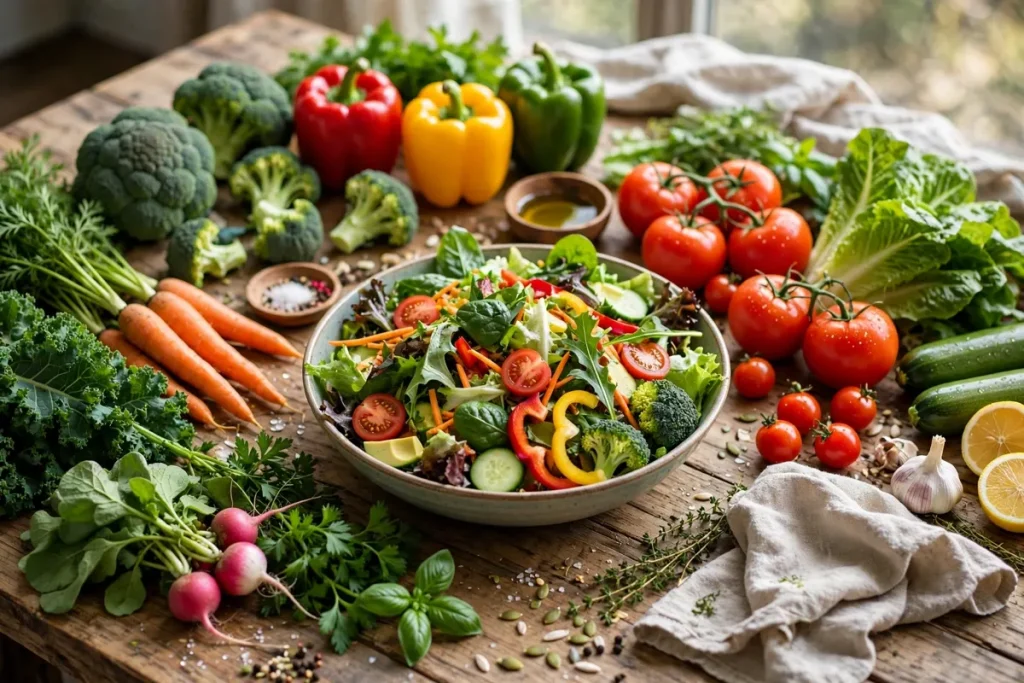

If you have ever looked at the small pile of peas on your plate and wondered whether it actually counts, you are not alone. Vegetables are the one part of healthy eating almost everyone agrees on, yet the target itself is strangely vague. One slogan says “eat more veg”, another says “5-a-day”, and a third tells you to fill half your plate. So how many servings of vegetables per day do you really need? This guide answers that with the two systems you will meet most often — USDA MyPlate and the WHO 5-a-day rule — and turns both into real food on a real plate.
Quick Answer
Quick answer: Most adults need 2 to 4 cups of vegetables a day, depending on their calorie needs, according to USDA MyPlate. Most women land at 2–3 cups and most men at 3–4 cups. In the other common system, used by the WHO, one portion is 80 g, and fruit and vegetables together should reach at least 400 g a day, with vegetables the bigger share. The honest gap: only about 1 in 10 adults actually hits the target. Most people manage about 1 cup — roughly half of even the lowest adult target.
The Official Numbers
USDA MyPlate sets the vegetable target from your daily calorie level, because someone who eats 3,000 kcal simply needs more food — including more vegetables — than someone who eats 1,600 kcal. Find your calorie row and you have your target; you do not need a separate rule for your age or sex beyond that.
| Your daily calories | Vegetables per day |
|---|---|
| 1,600 kcal | 2 cups |
| 2,000 kcal | 2.5 cups |
| 2,200 kcal | 3 cups |
| 2,600 kcal | 3.5 cups |
| 3,000 kcal | 4 cups |
Two groups need a quick footnote. Children need less — about 1–2.5 cups a day depending on age — and very active people should follow their calorie row, not their age: an adult training hard may sit in the 3,000 kcal row and genuinely need 4 cups. Equally, do not chase the number perfectly every single day. Hitting your row on most days, and averaging out across the week, is how real people actually eat.
What Counts as One Serving?
A “cup” of vegetables is not always a measuring cup of chopped veg, which is where most of the confusion starts. There are two rulers, and either one works — the trick is not to mix them in the same day’s count.
The USDA Cup-Equivalent Ruler
Under USDA MyPlate, one cup-equivalent looks like this:
- 1 cup of raw chopped vegetables, such as peppers, cucumber or carrots.
- ½ cup of cooked vegetables — cooking shrinks most vegetables, so less volume still counts the same.
- 2 cups of raw leafy greens such as spinach or lettuce. Leaves are light and airy, so they count at double volume.
- 1 medium tomato or 1 medium carrot.
- ½ cup of vegetable juice. It counts, but whole vegetables are better, because juice loses fibre.
The WHO and 5-a-Day Ruler
The WHO system used by the 5-a-day campaign is simpler, because it works in grams and handfuls. One portion is 80 g — roughly:
- a good handful of raw, cooked or frozen vegetables;
- 3 heaped tablespoons of cooked vegetables, such as peas, carrots or sweetcorn;
- a cereal-bowl-sized serving of salad.
Beans, peas and lentils count too — about 1 cup cooked. Decide whether you are counting them as a vegetable serving or as your protein, because they should not be counted as both at the same time. Either way, they are one of the cheapest, most filling ways to lift your total.
If weighing feels fussy, weigh 80 g of vegetables just a few times. After a week of doing that, your eye learns the portion and the scale can go back in the drawer — most people keep estimating surprisingly well afterwards.
Variety Matters — Eat the Rainbow
Three cups of nothing but cucumber would hit the volume target and still miss the point, because different vegetables carry different nutrients. USDA MyPlate therefore splits the weekly total into subgroups. At a 2,000 kcal level, the weekly pattern looks roughly like this:
- Dark green — spinach, broccoli and kale: about 1.5 cups a week.
- Red and orange — tomatoes, carrots, peppers and sweet potato: about 5.5 cups a week.
- Beans, peas and lentils: about 1.5 cups a week.
- Starchy — potatoes, corn and peas: about 5 cups a week.
- Other vegetables — cucumber, cabbage, onions, mushrooms and more: about 4 cups a week.
The simple translation is this: do not eat only one vegetable. Rotate colours across the week — something green on Monday, something orange on Tuesday, a bean chilli somewhere in between — and you cover the subgroups without counting anything. A bag of mixed frozen vegetables quietly does this job for you, which is why it earns its freezer space.
Why Bother?
Vegetables add volume to meals for very few calories — most provide just 15–35 kcal per 100 g — so your plate gets bigger without your calories doing the same. That is a rare trade in nutrition: more food, not less, as the strategy.
Fibre is the second payoff. It feeds the gut bacteria that support digestion and general gut health, and it slows how quickly a meal raises blood sugar, so energy stays steadier and the post-lunch slump is smaller. Most adults fall well short on fibre, and vegetables are one of the easiest ways to close that gap.
Then there are the quiet nutrients. Potassium helps support healthy blood pressure, and folate supports normal cell growth and general health — and vegetables, especially leafy greens and beans, are among the richest everyday sources of both. People who eat more vegetables also consistently find weight control easier, because meals fill them up. This is exactly how the meal plans on this site stay filling on a deficit: the vegetables do the volume work, so the plan never feels like a punishment.
How to Actually Hit It
Knowing the target is the easy part. These six habits are how people reach 2–4 cups without turning dinner into a salad-eating contest.
- Add vegetables to breakfast. Spinach or peppers folded into eggs, or tomatoes on toast, bank half a cup before the day has really started.
- Make lunch carry a full cup. A real salad or a vegetable soup does this easily; two lettuce leaves in a sandwich do not.
- Use the double-vegetable rule at dinner. Put two different vegetables on the plate instead of one — broccoli and peppers beats broccoli alone, every time.
- Swap the snack. Carrot and cucumber sticks with hummus give you the crunch of crisps, plus a serving, for similar effort.
- Let frozen count. Frozen peas, spinach and mixed vegetables are nutritionally on par with fresh, and they never rot in the fridge waiting for a recipe.
- Blend them in. Sauces, curries and smoothies quietly absorb 1–2 servings — wilted spinach disappears into a pasta sauce completely.
A Sample Day That Reaches About 3 Cups
Here is what an easy 3-cup day looks like. Breakfast is eggs with spinach and tomato (about ½ cup). Lunch is a big salad bowl (about 1.5 cups). A snack of carrot sticks adds ½ cup, and dinner brings broccoli and peppers (about 1 cup cooked, which counts as 1 cup). The total lands at roughly 3–3.5 cups — no suffering, no weighing every leaf, and no meal that looks like rabbit food.
Start smaller if 3 cups sounds like a leap. Add just one serving to the meal you already eat most reliably — for most people that is dinner — and hold that for two weeks. Once it feels automatic, add the next one at lunch. Habits stacked this way survive busy weeks far better than a heroic Monday overhaul that collapses by Thursday.
Two Honest Warnings
Two foods cause most of the arguments about vegetable servings, and both come down to preparation rather than the vegetable itself. Neither warning is a ban — plenty of people eat both foods happily inside a healthy diet. The point is simply not to let them quietly stand in for the servings this article has been counting.
1. Potatoes Count — Fries Are Not a Health Strategy
Potatoes count as a starchy vegetable in USDA guidance, and baked or boiled potatoes are a perfectly fine food. Fries and crisps are a different story: the oil and salt change the food, adding a lot of calories and sodium to the same potato. Enjoy them as the treat they are, but do not let them stand in for your vegetable servings.
2. Juice Is Not a Serving Shortcut
Half a cup of vegetable juice counts as a serving on paper, but it drops the fibre that does much of the work, and it is far less filling than eating the vegetable itself. If you like vegetable juice, keep it — just treat it as a bonus, and eat the vegetable when you can.
Your vegetable target is not a fixed number that everyone shares — it follows your calorie target. So before you plan portions, find your number first: here is how to work out how many calories should I eat daily. Once you know which row of the table is yours, your vegetable target picks itself — and, with the playbook above, it is much easier to reach than the 1-in-10 statistic suggests. Pick one habit this week, and let it carry you.
Frequently Asked Questions
How many servings of vegetables should an adult eat per day?
About 2 to 4 cups a day depending on calorie needs: most women 2–3 cups, most men 3–4 cups. In 5-a-day terms, aim for at least 3 vegetable portions (about 240 g) plus fruit on top.
Is the 5-a-day rule still correct?
Yes as a floor, not a ceiling: 5 portions of 80 g of fruit and vegetables combined (400 g) is the WHO minimum. Vegetables should be the larger share — think 3 veg + 2 fruit.
What does one serving of vegetables look like?
About 80 g: 1 cup of raw vegetables, ½ cup cooked, 2 cups of raw leafy salad, 1 medium tomato or carrot, or 3 heaped tablespoons of cooked vegetables.
Do potatoes count as a vegetable serving?
In USDA guidance, yes — they are a starchy vegetable. But preparation decides the health value: boiled or baked potatoes are fine; fries and crisps are mostly an oil-and-salt food.
Do frozen vegetables count?
Yes. Frozen vegetables are picked and frozen quickly, so their vitamin content is typically on par with fresh — and they remove the biggest excuse, which is fresh vegetables going off before you eat them.


Pingback: Red Onion Calories & Nutrition - Per Onion, Cup and 100 g
Pingback: Roma Tomato Calories & Nutrition - Per Tomato, Cup and 100 g
Pingback: Sweet Potato Fries Calories: Baked ~140 vs Fried ~280 (Per 100 g)