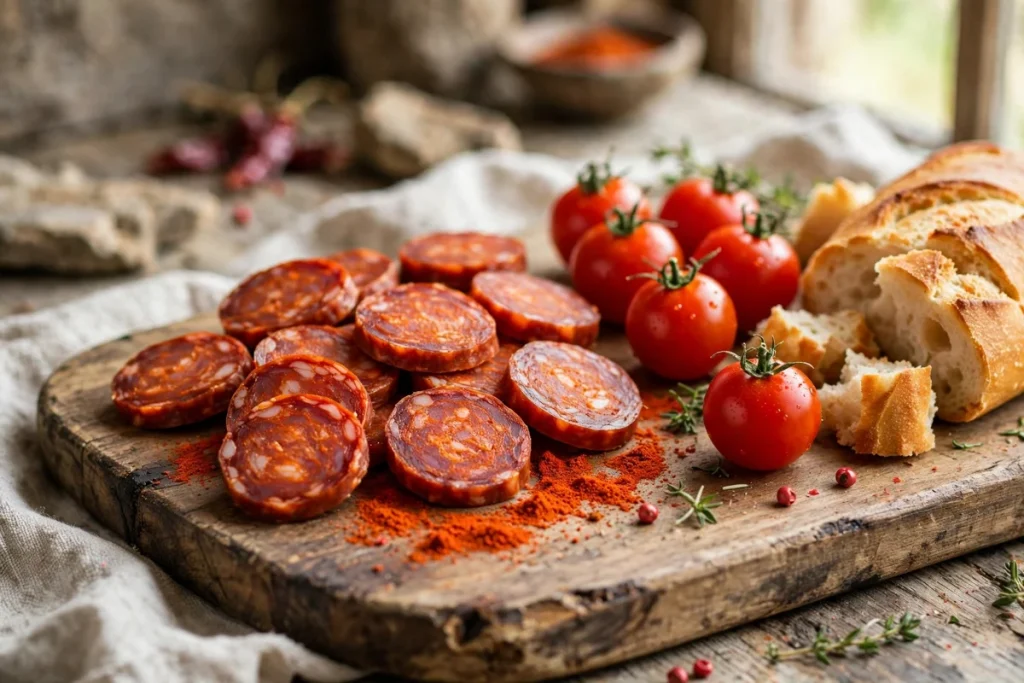

Is chorizo healthy? Honestly, not very. Chorizo is a processed pork sausage: tasty, protein-rich and packed with smoky flavour, but also high in calories, saturated fat and sodium. It counts as processed meat, which public health guidance treats as an eat-rarely food. That does not mean it is banned from your kitchen. Used as an occasional flavour booster in small amounts, chorizo is fine for most people. It just is not an everyday protein.
The first thing to know is that “chorizo” means two quite different sausages, and mixing them up is the easiest way to get the calories wrong.
Spanish vs Mexican chorizo: not the same sausage
Spanish cured chorizo
Spanish chorizo is dry-cured, so it is ready to eat: slice it cold for a board, or fry it briefly until the edges crisp. Curing removes water, which concentrates everything else. Per 100 g, Spanish chorizo has about 455 calories, 38 g of fat (14 g saturated), 24 g of protein and 1,230 mg of sodium. A typical 1 oz (28 g) serving — a few slices — is about 127 calories.
Mexican fresh chorizo
Mexican chorizo is fresh, raw sausage that must be cooked. It is sold loose or in links, crumbles as it cooks, and is seasoned with chilli and vinegar rather than cured. Per 100 g raw, it has about 273 calories, 23 g of fat (8.6 g saturated), 14 g of protein and 740 mg of sodium. A 2 oz (57 g) cooked portion, cooked down from about 2.5 oz raw, lands around 175 calories — labelled a cooked estimate, because fat renders out into the pan.
Chorizo nutrition compared
| Type | Serving | Calories | Fat | Saturated fat | Protein | Sodium |
|---|---|---|---|---|---|---|
| Spanish cured | 1 oz (28 g) | 127 | 10.6 g | 3.9 g | 6.7 g | 344 mg |
| Mexican fresh, cooked | 2 oz (57 g) | ~175 | ~14 g | ~5.5 g | ~10 g | ~525 mg |
The serving figures follow from the per-100 g values: 455 × 0.28 = 127.4, rounded to 127 calories for the Spanish serving, with fat, saturated fat, protein and sodium scaled the same way. The Mexican cooked serving is an estimate, because cooking and draining change both weight and fat: it is cooked down from about 2.5 oz raw, and some fat is left behind in the pan. For reference, per 100 g the two are: Spanish 455 calories, 38 g fat, 14 g saturated fat, 24 g protein, 1,230 mg sodium; Mexican raw 273 calories, 23 g fat, 8.6 g saturated fat, 14 g protein, 740 mg sodium.
The bottom line of the comparison: Mexican chorizo is the lighter of the two per 100 g, and draining it after cooking helps further. Spanish chorizo is denser because curing removes water, concentrating calories, fat and salt alike.
Why chorizo is heavy: three plain reasons
- Fat. About a third of chorizo’s weight is fat — Spanish chorizo is 38 g of fat per 100 g. Fat carries 9 calories per gram, so the calories stack up fast, even in a small serving.
- Sodium. A 2 oz portion of Spanish chorizo packs about 690 mg of sodium (344 mg × 2) — roughly a third of the 2,300 mg daily limit, before anything else on the plate. If salt is your main concern, our guide to low-sodium sandwich meats shows how processed meats compare.
- Processed-meat status. Chorizo is cured, often with nitrites, and public health guidance treats processed meat as an eat-rarely food. That is one calm reason to keep portions small — not a reason to panic about an occasional serving.
How to enjoy chorizo smarter
- Use it as a seasoning, not the main protein. Crumble a little into eggs, beans, soups or Mexican rice — you get the full smoky flavour for a fraction of the calories.
- Pair it with high-fibre foods. Beans, vegetables and whole grains balance a rich sausage and keep the meal filling.
- Drain Mexican chorizo well after cooking. Much of its fat renders into the pan; leaving that fat behind is the easiest calorie saving there is.
- Watch portions. A 1–2 oz flavour portion is a very different meal from a 4 oz main serving — and the difference is roughly 250–500 calories.
Healthier swaps that keep the flavour
| Swap | Serving | Calories | Why it works |
|---|---|---|---|
| Soy chorizo | 2 oz (57 g) | ~120 | Same spices, much less fat |
| Chicken or turkey chorizo-style sausage | 2 oz (57 g) | ~130 | Leaner poultry, similar seasoning (estimate) |
| Seasoned ground turkey | 2 oz (57 g) | ~85 | Smoked paprika and garlic mimic the flavour; 93% lean turkey is 170 cal per 4 oz, so 2 oz is about 85 cal and 10.5 g protein |
For the turkey swap, our guide to what to cook with ground turkey has nine ideas, and the calories in protein guide explains how protein counts toward your day.
The verdict
Chorizo is a flavour food, not a health food. It is high in calories, saturated fat and sodium, and it counts as processed meat. But food is not only nutrition: a little chorizo makes beans, eggs and rice taste wonderful, and once in a while, in a 1–2 oz portion, it fits fine into a balanced diet for most people. If you eat it often, the swaps above give you the same smoky flavour for far fewer calories.
Frequently Asked Questions
Is chorizo healthy?
Not very. Chorizo is a processed pork sausage that is high in calories, saturated fat and sodium, so it is best treated as an occasional flavour food rather than an everyday protein.
Is chorizo high in calories?
Yes. Spanish cured chorizo has about 455 calories per 100 g (127 per 1 oz serving), and Mexican fresh chorizo about 273 calories per 100 g raw (around 175 for a 2 oz cooked portion).
Which is healthier, Spanish or Mexican chorizo?
Mexican, on the numbers: fewer calories, less fat and less sodium per 100 g, especially once it is cooked and drained. Spanish chorizo is denser because curing removes water and concentrates fat and salt.
Can you eat chorizo on a diet?
Yes, in small amounts. Use 1 to 2 oz as a flavouring for eggs, beans or rice, count the calories, and pair it with vegetables or other high-fibre foods.
Is soy chorizo healthier?
Yes, on the numbers: about 120 calories per 2 oz with much less fat and the same smoky spices. Check the label for sodium, which varies by brand.