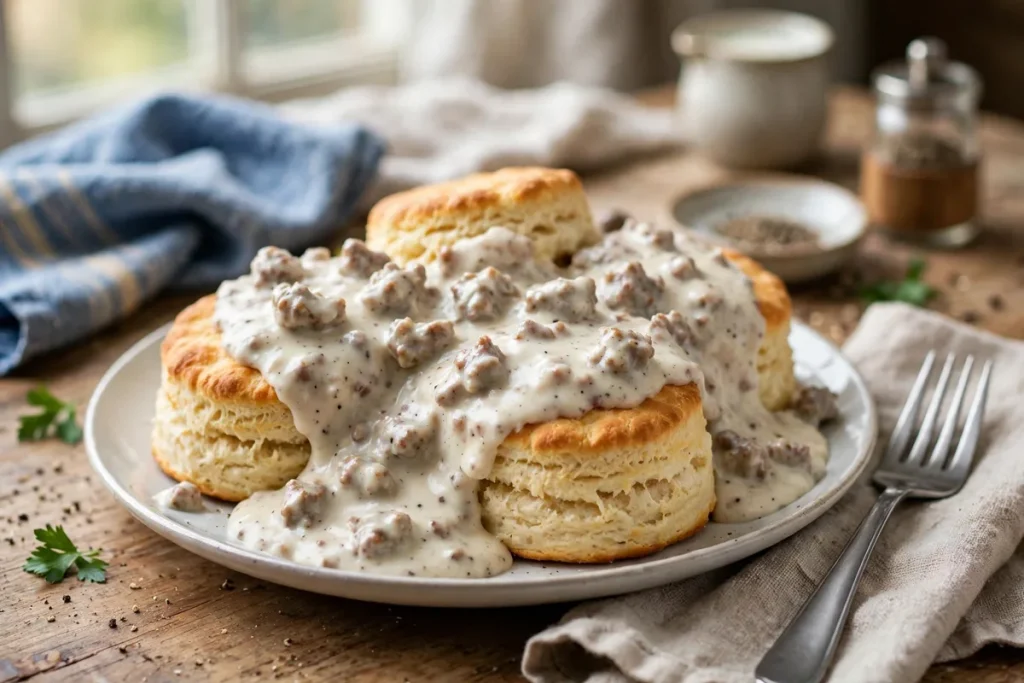

Biscuits and gravy is the kind of breakfast that looks innocent on the plate and lands like a full meal. A typical full plate comes in at about 440 calories, and the split underneath tells the story: the biscuit brings the butter and flour, while the sausage gravy brings most of the fat and nearly all of the sodium.
One honest note before the numbers: biscuits and gravy is a home and diner dish, not a packaged product, so there is no single official label for it. Every figure in this article is a typical value for a standard serving, labeled as typical throughout. Your plate will vary with the size of the biscuit, how much gravy is ladled on, and how fatty the sausage is, but the typical values below are a solid guide for ordering and cooking.

Biscuits and Gravy Calories by Portion
Portion size is everything with this dish. A half order is a genuinely different breakfast from a double plate, even though both are just biscuits and gravy. The table below uses the same typical values all the way through, so the portions are directly comparable. A full plate means one split biscuit, which is two halves, covered with about three quarters of a cup of sausage gravy.
| Portion | Calories (typical) |
|---|---|
| Half order (1 biscuit half + about 1/3 cup gravy) | About 280 |
| Full plate (1 split biscuit + about 3/4 cup gravy) | About 440 |
| Double plate (2 split biscuits + about 1 1/2 cups gravy) | About 880 (estimate) |
| Biscuit alone (1 plain biscuit) | About 230 |
| Sausage gravy (1/2 cup) | About 170 |
| Sausage gravy (1 cup) | About 340 |
The full plate also carries about 26 grams of fat, about 38 grams of carbohydrates, about 10 grams of protein and about 1,300 milligrams of sodium. That sodium figure is the one to notice: a single plate delivers well over half of the commonly cited 2,300 milligram daily limit. The double plate, at about 880 calories, is simply two full plates, and it is labeled as an estimate because it is built from the same typical parts rather than measured as its own serving.
Where the Calories Come From
Think of the plate as two foods that happen to share a plate. The biscuit is the first half of the story. A plain biscuit alone is about 230 calories, and that is mostly refined flour and butter: the layers that make a biscuit flaky are layers of fat, and the flour itself is dense in carbohydrates. On its own, a biscuit is already a substantial piece of bread, closer to a small pastry than to a slice of toast.
The gravy is the second half, and it is where the plate gets rich. Sausage gravy is about 170 calories per half cup, which means a typical three-quarter-cup ladle is roughly 255 calories before the biscuit is even counted. The calories come from two places: the rendered fat in the pork sausage and the milk that thickens into the gravy. Flour whisked into the drippings adds body and a few more carbohydrates, but the fat is the main driver. This is also why gravy calories swing so much from kitchen to kitchen: a leaner sausage and skim milk make a noticeably lighter gravy than a fatty sausage with whole milk and extra drippings.
Then there is the sodium, which deserves its own warning. A full plate carries about 1,300 milligrams of sodium, most of it from the sausage and the salted gravy base. That is more than half of the commonly cited 2,300 milligram daily limit in a single breakfast, before coffee, eggs or anything else on the table. If sodium is something you watch, this is the dish to plan around, and our guide to low sodium foods is a good place to see what a lighter-sodium day can look like. At a diner, the simplest sodium cut is the same as the calorie cut: order the half order and ask for the gravy on the side, so you control how much actually lands on the biscuit.
A Lighter Homemade Version (About 300)
The good news is that biscuits and gravy is one of the easiest breakfasts to lighten at home, because every heavy part has a direct swap. The lighter homemade version below lands at about 300 calories, and that figure is an estimate built from the same typical parts as the rest of this article, not a measured laboratory value. Three changes do most of the work.
First, swap the pork sausage for turkey sausage. Turkey sausage is much leaner, so the gravy keeps its savory, peppery character with far less rendered fat. Second, make the gravy with skim or low-fat milk instead of whole milk, and go easy on any extra butter in the pan; the flour will still thicken it into a proper gravy. Third, use one smaller biscuit instead of a large bakery biscuit, and split it so the gravy covers both halves. A smaller biscuit still gives you the full biscuits-and-gravy experience, just in a portion that fits the lighter total.
Put together, that lighter plate is about 300 calories, roughly 140 fewer than the typical full plate, and it usually comes with less fat and less sodium too, since turkey sausage and low-fat milk both cut salt and fat at once. Two more habits help without changing the recipe: measure the gravy with a ladle or a half-cup measure instead of pouring freely, and round the plate out with fruit or a side of eggs rather than a second biscuit. The goal is not to give up a favorite breakfast, but to keep it in the rotation in a version you can enjoy more often.
Ordering at a diner takes a little strategy, because the default plate is usually the biggest one. The half order is the single best move: at about 280 calories it still tastes like the real thing, and it leaves room for coffee and fruit without turning breakfast into a thousand-calorie event. If a half order is not on the menu, ask for one biscuit instead of two, or for the gravy on the side so you can spoon on what you want rather than swimming in what the kitchen poured. And skip the second helping of gravy, which is the easiest way to add another 170 calories without noticing.
It is also worth saying why this breakfast feels so satisfying despite its size. With about 10 grams of protein and 26 grams of fat, a full plate is rich and slow to digest, which is exactly why it became a working breakfast in the first place. The trade-off is calorie density: the same richness that keeps you full also packs a lot of energy into a small plate. Enjoying it occasionally, in the half order or the lighter homemade version, is the way to keep the comfort without the cost.
Frequently Asked Questions
How many calories in biscuits and gravy?
About 440 calories for a typical full plate: one split biscuit covered with about 3/4 cup of sausage gravy. That plate also carries about 26 grams of fat and about 1,300 milligrams of sodium.
How many calories in a half order?
About 280 calories for a half order of one biscuit half with about 1/3 cup of gravy. It is the easiest way to enjoy the dish for roughly 160 fewer calories than the full plate.
How many calories in just the biscuit?
About 230 calories for one plain biscuit on its own. Most of that comes from refined flour and the butter layered into the dough.
How many calories in sausage gravy alone?
About 170 calories per 1/2 cup of sausage gravy, or about 340 per cup. The calories come mainly from the sausage fat and the milk.
Are biscuits and gravy healthy?
They are a rich occasional breakfast rather than an everyday one: high in fat and sodium, with about 1,300 milligrams of sodium on a full plate. The lighter homemade version, made with turkey sausage, skim or low-fat milk gravy and one smaller biscuit, lands near 300 calories.
The bottom line is simple: biscuits and gravy is a 440-calorie breakfast at full size, a 280-calorie breakfast at half size, and a roughly 300-calorie breakfast in its lighter homemade form. Knowing which plate you are actually eating is half the battle, and the other half is the gravy ladle. Keep the portion honest, and this Southern classic stays a pleasure rather than a surprise.