
The best glutes workouts are built on one movement: hip extension. That means hip thrusts and glute bridges for the glute max, plus a squat pattern, a hinge in the form of the Romanian deadlift, a single-leg move and an abduction move. Train glutes twice a week, add weight or reps over time, and eat enough to grow — our guide to calories for glute gain covers the food side of the equation.
Your glutes are three muscles, not one. The gluteus maximus is the big power muscle that drives hip extension and gives the glutes their shape. The gluteus medius and minimus sit on the side of the hip: they stabilise your pelvis when you walk or stand on one leg, and they move your leg out to the side. A good program trains all three, which is why the list below mixes heavy compounds with single-leg and side work.
The 8 best glutes exercises
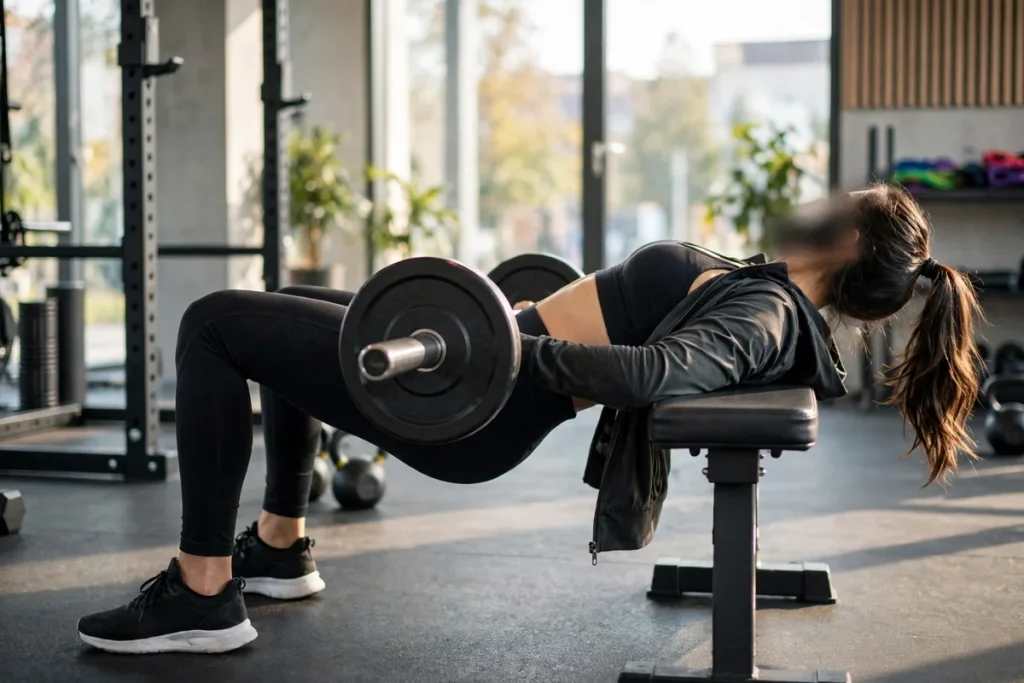
1. Barbell hip thrust — 4×8–12
What it hits: glute max. The hip thrust loads the glutes hardest at full extension, which is exactly where they are strongest, so you can move serious weight with it. Form cue: chin tucked, ribs down, drive through your heels and pause for a second at the top before lowering under control.
2. Romanian deadlift — 3×8–12
What it hits: glute max and hamstrings. The Romanian deadlift trains the hinge pattern and stretches the glutes under load, which makes it a perfect partner to the hip thrust. Form cue: push your hips back like you are closing a door with your backside, keep the bar close to your legs, and stop when you feel a strong stretch in your hamstrings.
3. Bulgarian split squat — 3×8 per leg
What it hits: glute max and quads, one leg at a time. Single-leg work fixes left-right imbalances and forces the glutes to stabilise your pelvis. Form cue: lean your torso slightly forward, keep most of your weight on your front heel, and think about pushing the floor away from you.
4. Cable kickback — 3×12–15
What it hits: glute max, in isolation. Kickbacks will not build glutes on their own, but they are a great finisher after the heavy work, when the glutes are already tired. Form cue: keep your hips square to the floor and squeeze at the back without arching your lower back.
5. Sumo squat — 3×10–12
What it hits: glute max and inner thighs. The wide stance and turned-out feet let you sit deep between your hips, which puts the glutes in a strong position. Form cue: knees track over your toes, chest stays tall, and drive up through your whole foot.
6. Step-ups — 3×10 per leg
What it hits: glute max, one leg at a time. Step-ups are a gym-friendly single-leg move that carries over to stairs, hills and running. Form cue: step onto a bench or box, lean slightly forward, and drive up through your top heel without pushing off with your floor leg.
7. Glute bridge — 3×12–15
What it hits: glute max. The glute bridge is the home-friendly version of the hip thrust: no barbell needed, and you can add a resistance band or a backpack for weight. Form cue: place your feet close enough that you can just touch your heels with your fingertips, and squeeze hard at the top.
8. Standing cable or band abduction — 2×15–20
What it hits: glute medius and minimus. This is the side work that keeps your hips stable and rounds out the program. Form cue: stand tall, move your leg straight out to the side, and do not lean away from the working leg.
The 8 exercises at a glance
Here is the whole list in one table, so you can screenshot it for the gym.
| Exercise | Main target | Sets × reps | Equipment |
|---|---|---|---|
| Barbell hip thrust | Glute max | 4×8–12 | Barbell and bench |
| Romanian deadlift | Glute max + hamstrings | 3×8–12 | Barbell or dumbbells |
| Bulgarian split squat | Glute max + quads | 3×8 per leg | Dumbbells and bench |
| Cable kickback | Glute max | 3×12–15 | Cable machine |
| Sumo squat | Glute max + inner thighs | 3×10–12 | Dumbbell or kettlebell |
| Step-ups | Glute max | 3×10 per leg | Bench and dumbbells |
| Glute bridge | Glute max | 3×12–15 | None, or a band |
| Standing cable or band abduction | Glute medius and minimus | 2×15–20 | Cable or band |
Two ready routines
Routine A: Gym glute day (about 45 minutes)
Work through the exercises in order, resting about 90 seconds between sets of the heavy compounds and about 60 seconds between sets of the isolation moves.
- Barbell hip thrust: 4×8–12
- Romanian deadlift: 3×8–12
- Bulgarian split squat: 3×8 per leg
- Cable kickback: 3×12–15
- Standing cable abduction: 2×15–20
Routine B: Home, no equipment (about 25 minutes)
No barbell, no problem. Slow the tempo down and pause for two seconds at the top of every rep — that makes bodyweight work much harder. If you have a resistance band, loop it above your knees for the bridges. If you are new to structured training, our beginner workout plan shows how to fit a glute day into a full week, and our calisthenics workout is a good next step if you want a full bodyweight routine.
- Glute bridge: 3×15
- Bodyweight sumo squat: 3×15
- Reverse lunge: 3×10 per leg
- Donkey kick: 3×15 per leg
- Frog pump: 3×20
How many calories does a glute workout burn?
These are ESTIMATES, based on MET values for resistance training. At a moderate-to-hard effort, lifting weights runs about 5–6 METs, which works out to roughly 6–7 calories per minute for a 155 lb (70 kg) person. The maths, shown once: 6.5 calories per minute × 45 minutes ≈ 290 calories, which sits inside the range below.
A 45-minute gym glute session burns about 250–300 calories at 155 lb. A 25-minute home bodyweight session burns about 150–200 calories. Lighter people burn a little less, heavier people a little more. The honest point: glute training is not a big calorie burner. Its payoff is muscle, strength and shape — if fat loss is the goal, the food side matters far more, which is why we keep pointing you to the calories guide.
Progression rules: how glutes actually grow
- Add weight or reps when the last set feels easy. If you finish your final set and feel you could have done three or more extra reps, go heavier or add reps next session.
- Train glutes twice a week, with at least 48 hours between sessions, so the muscle has time to recover and rebuild.
- Soreness is not the goal. Chasing soreness usually just means you did something new, not something better. Progress in weight and reps is the signal that matters.
Mistakes that stall glute growth
- Only doing banded kickbacks. Bands are a warm-up and a finisher, not a replacement for heavy hip thrusts and deadlifts.
- Never adding weight. The same dumbbells for six months give you the same glutes for six months.
- Quad-dominant squats with knees caving in. If your knees collapse inward, your glutes are not doing their job — lighten the load, push your knees out gently, and sit back more.
- Skipping food. Muscle cannot be built from nothing: if you train hard and eat too little, your glutes will not grow. Our calories for glute gain guide works out the surplus for you.
Frequently Asked Questions
What is the best workout for glutes?
A session built around the barbell hip thrust, plus a hinge like the Romanian deadlift and a single-leg move like the Bulgarian split squat, done twice a week. That combination covers the glute max, medius and minimus better than any single exercise.
How often should I train glutes?
Twice a week is the sweet spot for most people, with at least 48 hours between sessions so the muscle can recover and grow. Once a week can maintain what you have, but progress is slower.
Can I build glutes at home without equipment?
Yes, especially as a beginner. Glute bridges, sumo squats, reverse lunges, donkey kicks and frog pumps all work without equipment. When bodyweight gets easy, add a resistance band or a loaded backpack.
How long until glutes grow?
Strength usually improves within a few weeks, but visible change typically takes 8–12 weeks of consistent training twice a week plus enough food. Judge progress by your training log and photos, not the mirror day to day.
Do glute workouts burn many calories?
Not a huge amount. A 45-minute gym glute session burns an estimated 250–300 calories at 155 lb, and a 25-minute home session about 150–200 calories. Glute training pays off in muscle and strength, not calorie burn.