
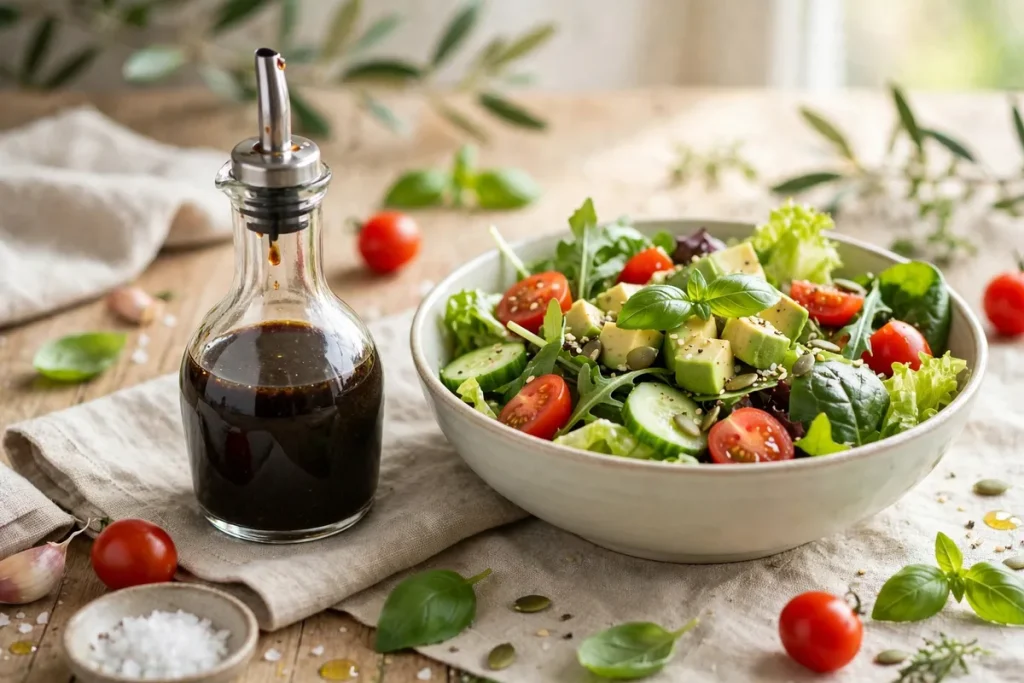

Balsamic vinaigrette calories are about 90 per 2 tablespoons for a typical store-bought bottle, with about 3 grams of sugar. That is the honest headline number, and it comes with a twist most people do not expect: the homemade version you whisk up yourself usually runs higher, at about 140 per 2 tablespoons. The reason is simple, and it is the whole story of this dressing: oil is where the calories live, and a homemade vinaigrette is mostly oil.
Two tablespoons is also a small pour. It is the serving size printed on the label, and it is roughly what you get when you drizzle carefully over a single salad. It is not what most restaurant salads arrive with, and it is not what a generous home pour looks like either. Keep that gap in mind through the numbers below, because the difference between the label and the bowl is where dressing calories quietly double.
One note before the tables: the values in this article are typical label and recipe values, and brands and recipes differ. A bottle that leans sweet will carry a little more sugar, and a homemade batch depends entirely on your ratio. Treat these as planning numbers, not laboratory figures.
Balsamic Vinaigrette Calories by Type
Start with the version you are most likely to buy or make. The store-bought regular is the middle of the range, the homemade classic is the top, and the light and fat-free bottles sit well below, with a trade-off worth knowing about.
| Type | Calories per 2 tablespoons | Calories per tablespoon |
|---|---|---|
| Store-bought regular balsamic vinaigrette | About 90 | About 45 |
| Homemade (3 parts oil to 1 part vinegar) | About 140 | About 70 |
| Light balsamic vinaigrette | About 35 | About 18 |
| Fat-free balsamic vinaigrette | About 15-20 | About 8-10 |
| Plain balsamic vinegar (no oil) | About 28 | About 14 |
The light and fat-free versions earn their low numbers by replacing oil with water, which is why they taste thinner and often carry a little more sugar and sodium to make up for the missing richness. That is a fair trade if calories are your priority, but check the label: a fat-free dressing that adds sugar is not automatically the healthier bottle, just the lower-calorie one.
Plain balsamic vinegar on its own is a different food from vinaigrette, calorie-wise. At about 14 calories per tablespoon and 2 to 3 grams of sugar, it is nearly free, which is why a vinegar-and-mustard drizzle, or a vinaigrette stretched with extra vinegar, can cut the dressing bill so sharply. The moment oil enters, the numbers climb, and the next section explains exactly why.
The Oil Ratio Decides It
A classic homemade vinaigrette follows a 3-to-1 ratio: three parts oil to one part vinegar. That means roughly three-quarters of every spoonful is oil, and olive oil alone runs about 119 calories per tablespoon. The vinegar, mustard, and seasoning in the mix dilute the total a little, which is why the finished dressing lands at about 140 per 2 tablespoons rather than at pure-oil math, but the direction is unmistakable. More oil, more calories, no matter how good the oil is.
This is also why homemade runs higher than store-bought. Bottled dressings are usually thinner, with more water and vinegar in the blend, so the oil share drops and the label reads about 90 instead of 140. Neither number is wrong; they are just different recipes. If you make your own and want the bottled number, you have to use the bottled ratio, or something close to it.
The practical lever is the ratio itself. Dropping from 3 parts oil to 1 part oil and 1 part vinegar, then stretching the dressing with water and a spoonful of Dijon mustard for body, can land a lighter homemade version near 70 to 80 calories per 2 tablespoons (estimate). The mustard matters: it helps the oil and vinegar hold together, so the dressing still coats leaves instead of sliding off into a puddle at the bottom of the bowl. You keep the balsamic flavor and lose roughly half the calories.
One more ratio note: measuring matters more than the recipe. A free-poured glug from a cruet is easily 3 or 4 tablespoons, and at 70 calories a tablespoon for homemade, that is 210 to 280 before you have added a single topping. A tablespoon measure, used once, is the cheapest calorie tool in this whole article.
Balsamic vs Other Dressings
So where does balsamic sit among the usual bottles? Squarely in the middle. It is lighter than the creamy dressings, heavier than a plain oil-and-vinegar splash made mostly with vinegar, and nearly tied with Italian dressing.
| Dressing | Calories per 2 tablespoons |
|---|---|
| Balsamic vinaigrette | About 90 |
| Italian dressing | About 85 |
| Ranch dressing | About 140 |
| Caesar dressing | About 160 |
| Straight olive oil | About 238 |
Two things stand out. First, ranch and Caesar cost about the same as homemade balsamic, so switching from ranch to a store-bought balsamic genuinely saves about 50 calories per serving. Second, straight olive oil is the most expensive pour of all at about 238 per 2 tablespoons, a reminder that just oil is not a light choice, even when the oil itself is a healthy fat. Healthy fats still carry 9 calories per gram, the same as any fat.
The comparison that matters most is not balsamic versus ranch, though. It is any dressing versus the amount you actually pour, which is the subject of the next section.
The Real Salad Math
Here is the number that changes how you read the rest of this article: a restaurant or home salad often gets a quarter cup of dressing, not the label’s 2 tablespoons. A quarter cup is 4 tablespoons, and at about 45 calories per tablespoon of regular store-bought balsamic, that is about 180 calories of dressing before anything else in the bowl. With homemade at about 70 per tablespoon, the same pour is about 280.
That does not make the salad a bad meal. A big bowl of greens, vegetables, and a protein still lands well under most restaurant entrees, and the dressing is doing real work: it carries flavor and helps you absorb vitamins from the vegetables. It just means the dressing deserves a line in your mental math, not a free pass because it arrived on lettuce.
Two tactics keep the number honest without making salad joyless. First, ask for dressing on the side and dip your fork in it before each bite; most people use 1 to 2 tablespoons that way, or about 45 to 90 calories of store-bought balsamic, instead of 180. Second, at home, dress the salad in the bowl with a measured 2 tablespoons and toss well: a coated leaf needs far less dressing than a drowned one. If you are building a heartier bowl, a scoop of chicken salad brings its own creamy richness, so the vinaigrette can stay light. The two dressings do not both need to be poured generously.
The same math applies in reverse, too. If you love a full quarter cup of dressing and you count it, about 180 for store-bought balsamic, you can still fit it comfortably into most days. The trap was never the dressing itself. It was the dressing you did not count.
Balsamic vinaigrette is a good dressing choice: about 90 calories per labeled serving store-bought, mid-pack against other dressings, and easy to lighten by changing the oil ratio or simply measuring the pour. The bottle is not the problem. The pour is the whole story.
One last label tip: when you compare bottles, check the serving size before the calorie number. Some light dressings print a 1-tablespoon serving, which makes their calories look half as big, and some restaurant-style bottles list 2 tablespoons while the bottle itself holds 12 servings. The fair comparison is always calories per 2 tablespoons, the standard most vinaigrettes use. Once you line the bottles up that way, balsamic’s middle-of-the-pack position is easy to see, and the bottle that looked lightest is often just the one with the smallest printed spoon.
Frequently Asked Questions
How many calories are in balsamic vinaigrette?
About 90 calories per 2 tablespoons for a typical store-bought bottle, and about 140 per 2 tablespoons for a classic homemade version made with 3 parts oil to 1 part vinegar.
How many calories are in a tablespoon of balsamic vinaigrette?
About 45 calories per tablespoon store-bought, and about 70 per tablespoon homemade.
Is balsamic vinaigrette healthier than ranch?
On calories, yes: about 90 calories per 2 tablespoons versus about 140 for ranch. Balsamic also tends to be lower in saturated fat, but portion still decides the total, so measure the pour either way.
How many calories are in balsamic vinegar alone?
About 14 calories per tablespoon, or about 28 per 2 tablespoons. The vinegar is nearly free; it is the oil in vinaigrette that adds the calories.
Why is homemade balsamic vinaigrette higher in calories?
Because the classic recipe is 3 parts oil to 1 part vinegar, and olive oil alone runs about 119 calories per tablespoon. Bottled dressings use more water and vinegar, so their oil share, and their calorie count, is lower.


Pingback: Honey Mustard Calories — Per Tablespoon, Per Cup and as a Dip