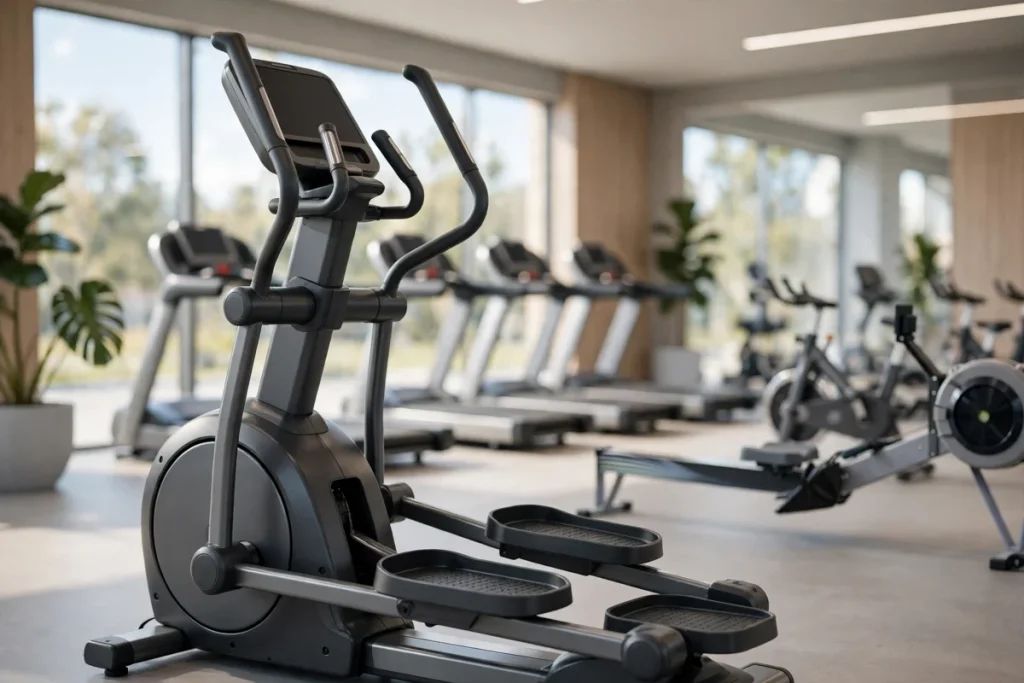

The adaptive motion trainer — usually shortened to AMT — is the cardio machine that refuses to pick a single motion. Made by Precor, it automatically adjusts its stride to yours: start with short, tall steps and it feels like a stair climber; lengthen your stride and it turns into a walk, then a run — all without pressing a button to change mode.
The direct answer to the question everyone asks first: a typical 30 minutes on the adaptive motion trainer burns roughly 270–400 calories, depending on your body weight and how hard you work. Those are estimates, not console gospel — the table below shows exactly where they come from.
How the adaptive motion trainer works
The trick is Precor’s Open Stride design. On a normal elliptical, the pedals travel a fixed path — the same ellipse every step. On the AMT, the pedals can move in different paths, and the machine reads the stride you naturally take and follows it. Two things change at once: stride length (how far forward each step reaches) and stride height (how high each step lifts). Short, high steps feel like climbing stairs; long, flat steps feel like running; anything in between feels like walking.
You never press a button to switch between those motions. You just change how you move, and the machine adapts mid-stride. Resistance is still adjustable — a dial or buttons set how hard each step feels — but the motion pattern itself is yours, not a preset.
The other half of the appeal is impact. Your feet stay on the pedals for the whole session, so there is no foot strike and no landing shock the way there is on a treadmill. That is why the AMT shows up in gyms as the joint-friendlier option next to the running machines.
Adaptive motion trainer calories burned (estimates)
Every figure on this page is an estimate. There is no single official AMT calorie table, so these numbers are MET-based — the same method used in our other machine guides — treating a vigorous AMT session as comparable to vigorous elliptical work at roughly 8–10 METs. The table uses 9 METs, the middle of that range, with the standard formula: calories per minute = METs × 3.5 × body weight in kg ÷ 200. At a gentler 8 METs, expect figures roughly 10% lower; at a hard 10 METs, roughly 10% higher.
| Body weight | 30 minutes | 60 minutes |
|---|---|---|
| 125 lb (57 kg) | ~270 | ~540 |
| 155 lb (70 kg) | ~330 | ~660 |
| 185 lb (84 kg) | ~400 | ~800 |
Two things to note. First, the 60-minute figures are simply double the 30-minute ones — burn scales with time at a steady effort. Second, the 270–400 range from the introduction is just the 30-minute column read across body weights: the lightest person burns about 270, the heaviest about 400. Your machine’s console may show more, because consoles often assume a heavier default body and a perfect, unsupported effort.
AMT vs elliptical vs treadmill
The honest headline first: at the same effort, the AMT does not magically burn more calories than an elliptical. Its advantage is variety and a more natural stride, not a bigger burn.
| Machine | Impact | Calories at similar effort | Muscles worked | Best for |
|---|---|---|---|---|
| Adaptive motion trainer | Low — feet stay on pedals | Similar to an elliptical | Legs, glutes and core; arms too if you use the moving handles | Variety seekers and joint-sensitive users |
| Elliptical | Low | Similar | Legs, glutes and arms (with moving handles) | Steady, predictable cardio sessions |
| Treadmill | Medium to high when running | Similar at the same effort; higher at fast running speeds | Legs, glutes and calves | Runners and pace training |
If the treadmill row wins you over, our treadmill pace chart converts belt speed to minutes per mile, so you can set the belt to a real training pace instead of guessing.
Benefits — and who it suits
- Joint-friendly: low impact with no foot strike, a genuine option when running hurts.
- Boredom-proof: stair climbing, walking and running in one session without touching a program menu.
- Every fitness level: beginners take short, easy strides; fitter users open up into long, hard running strides on the same machine.
- Interval-ready: switching motions is instant, so hard and easy intervals need no button presses.
- Full-body option: moving handles bring the arms in, though the legs still do most of the work.
Put together, it suits joint-sensitive users, variety seekers, and anyone from first-timer to experienced gym-goer who wants a cardio session that does not feel identical every time.
The limits
The AMT’s biggest limit is where you find it. It is a commercial gym machine — big, heavy and expensive — so it is not a realistic home purchase for most people. Availability varies by gym, so check the cardio floor before you plan a routine around it. Many gyms carry Precor AMTs, and if your gym is a Planet Fitness, you may spot one near the cardio deck — our Planet Fitness red light therapy guide covers another piece of kit you can use on the same visit.
There is also a short learning curve. The first session can feel strange while the machine learns your stride and you learn its range — give it a full session before judging it. And if you want a fixed, repeatable motion for steady rehab-style work, a standard elliptical’s locked-in path may suit you better.
A 20-minute beginner workout
Use this as a first session. Keep the resistance moderate and let the stride change do the work.
| Phase | Time | What to do |
|---|---|---|
| Warm-up | 0:00–5:00 | Easy, short strides at light resistance; find a comfortable rhythm |
| Climb | 5:00–9:00 | Short, tall strides like stair climbing at moderate resistance |
| Stride | 9:00–13:00 | Longer, flatter strides at a brisk pace |
| Climb again | 13:00–17:00 | Back to short, tall strides, slightly harder than the first climb |
| Cool-down | 17:00–20:00 | Easy strides at light resistance until your heart rate settles |
Use the talk test: you should be able to speak in short sentences during the work intervals. If you cannot, ease off the resistance or shorten the stride until you can.
Form tips
- Stand tall: upright posture, eyes forward, a slight forward lean at most — do not hunch over the console.
- Keep your hands light: the handles are for balance and arm work, not for holding your weight. Leaning on them quietly cuts the burn — our StairMaster guide explains the same handrail trap.
- Push through the whole foot: press from heel to toe rather than bouncing on your toes, so the glutes and hamstrings share the work.
- Let the stride find you: do not force a long running stride on day one — start short and let it lengthen as you warm up.
Is the AMT good for weight loss?
Yes, as one part of a calorie deficit. A 155 lb person burning roughly 330 calories in 30 minutes, three or four times a week, adds up to around 1,000–1,300 calories a week from the AMT alone — a real contribution, but not a whole weight-loss plan by itself. Whether that puts you in a deficit depends on how much you eat versus your maintenance calories, which our maintenance calories calculator can estimate for you.
Frequently Asked Questions
What is an adaptive motion trainer?
It is a Precor cardio machine whose pedals adapt to your stride. Short, tall steps feel like stair climbing, longer flat steps feel like walking or running, and the machine switches between those motions automatically — you never press a button to change mode.
How many calories does the adaptive motion trainer burn?
As an estimate, about 270 calories in 30 minutes at 125 lb, about 330 at 155 lb and about 400 at 185 lb during a vigorous session, with 60-minute figures roughly double. These are MET-based estimates at 9 METs, so your machine console and your actual effort will shift the numbers.
Is the AMT better than an elliptical?
For calorie burn alone, no — at the same effort the two are similar. The AMT is better if you want variety and a stride that adapts to you, and worse if you want a fixed, predictable motion or a machine you can afford at home.
Is the adaptive motion trainer good for knees?
Generally yes. The motion is low impact and your feet stay on the pedals, so there is no landing shock like running. Anyone with an existing knee condition should check with their own clinician or physiotherapist before starting a new machine.
Is the AMT good for weight loss?
Yes, as part of a calorie deficit. A 30-minute session burns roughly 270 to 400 calories depending on body weight, so three or four sessions a week add up to a meaningful weekly total — but the deficit itself still comes from eating less than your maintenance calories.