
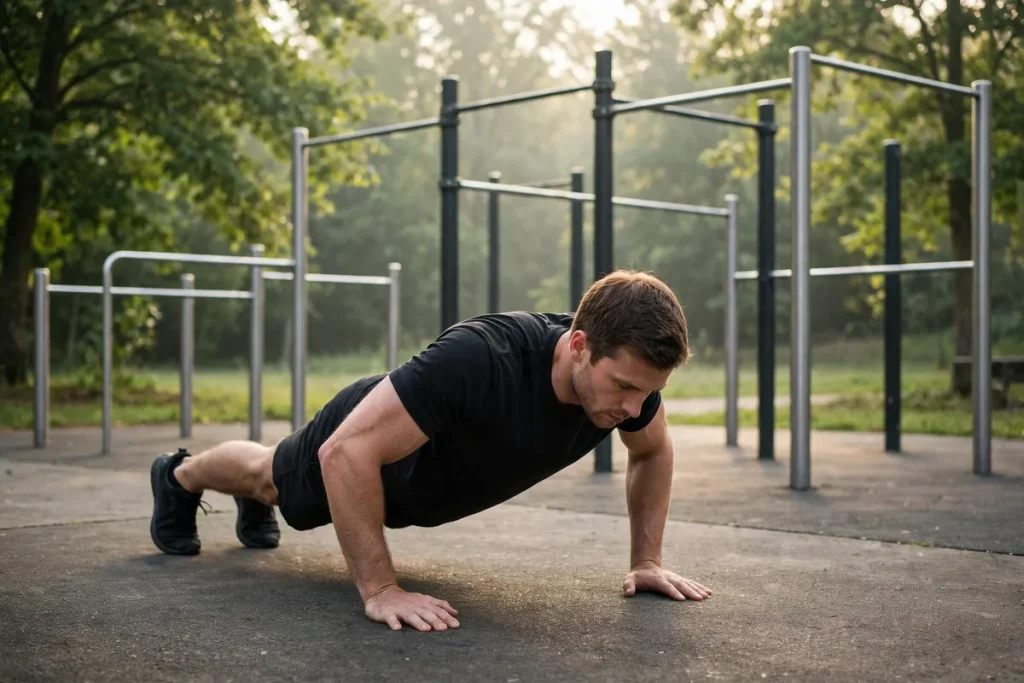

Calisthenics is strength training with your own bodyweight — push-ups, rows, squats, dips and core work, done wherever there is floor. There is no gym to join and almost no equipment to buy: your body is the weight stack, and progressions — easier and harder versions of every move — are how you adjust the load. This calisthenics workout is a 3-day full-body routine built on 6 fundamental movements, with a progression ladder for each one, so a complete beginner and a fairly strong trainee can both start at their own step and keep climbing.
It is genuinely for everyone with a floor and 40 minutes: students, parents, travelers, and anyone whose nearest gym is too far or too expensive to use three times a week. One honest note before you start: if you have a health condition or an injury, or you are returning to exercise after a long break, check with your doctor first — and stop any exercise that causes sharp pain.
No commute, no queue for equipment, no monthly fee — the only barrier to starting is one session on your living-room floor, today.
The 6 Movements That Cover Everything
Every calisthenics program, from a first-week routine to an athlete’s park session, is built from the same six movement patterns. Master these and there is no major muscle group left untrained:
Push: the push-up. Trains the chest, shoulders and triceps — the classic horizontal push, and the foundation everything else in pressing builds on.
Pull: the row, and later the pull-up. Trains the back and biceps — the half of upper-body training that push-ups cannot do, and the reason calisthenics athletes keep balanced, healthy shoulders.
Squat pattern: the bodyweight squat. Trains the quads and glutes through the knee-and-hip bend that every lower-body day, and every flight of stairs, starts from.
Hinge and legs: the glute bridge and single-leg Romanian deadlift pattern. Trains the glutes, hamstrings and spinal stability — the back-of-body chain that a desk job quietly switches off.
Vertical push: pike push-ups and dips. Trains the shoulders and triceps in the overhead direction — the pressing angle a standard push-up misses.
Core: hollow holds and leg raises. Trains the deep abdominals and hip flexors as one bracing system — the transfer point that makes every other movement stronger and safer.
Training by pattern rather than by body part is what makes six movements enough. A machine trains one muscle while the rest of you watches; a push-up trains the same push pattern while your core braces, your glutes squeeze and your shoulders stabilize — which is why calisthenics strength transfers so well to real life, work and sport.
Notice what is not on the list: no isolation exercises, no machines, nothing that trains one small muscle while the rest of you watches. Six patterns, trained together, are a complete strength program — the routine below is simply those six patterns organized into a week.
Progressions: Every Move Has an Easier and Harder Version
A barbell program adds plates when a lift gets easy. A calisthenics program changes the leverage instead. Each movement below is a ladder: the steps on the left are easier, the steps on the right are harder, and somewhere on each ladder is the step that challenges you today. That ladder is the entire secret of bodyweight training — it is how a person who cannot do one push-up and a person training for a one-arm push-up are doing the same workout, just on different rungs.
| Movement | Easier → Harder |
|---|---|
| Push-Up | Wall push-up → incline push-up → full push-up → diamond push-up → pseudo-planche push-up |
| Row / Pull-Up | Table row → horizontal row → negative pull-up → pull-up |
| Squat | Assisted squat → bodyweight squat → split squat → pistol squat progression |
| Dips | Bench dip → between-chairs dip → parallel-bar dip |
| Core | Dead bug → hollow hold → hanging knee raise → leg raise |
Find your step with a quick test: try the middle step of a ladder for one set. If you cannot complete the bottom of the rep range with clean form, drop one step easier. If the top of the range feels easy, try one step harder. Your starting step is where the last two reps of a set are hard but tidy — not the step where your form falls apart.
Then follow the one rule that drives everything: when the top of the rep range feels smooth for two sessions in a row, move ONE step harder. Not two steps — one. A step that feels slightly too easy for a week is a step your joints and tendons are quietly thanking you for, and steady single steps are how people go from wall push-ups to diamond push-ups without ever hitting a wall.
Every step assumes strict form: full range of motion, no bouncing at the bottom, and a controlled tempo — about two seconds down, one second up. If the last two reps of a set turn ugly, the set is over. Stop there, write it down, and beat it next time.
Write your current step for every ladder in your log next to the sets and reps. Six weeks from now, comparing step numbers is the clearest picture of progress you can get — clearer than the mirror, and far clearer than memory.
The Beginner Routine (3 Days a Week)
Run this session three days a week — Monday, Wednesday and Friday is the classic layout — with at least one rest day between sessions. Every exercise uses the step of its ladder that matches your strength today, so two people can follow this exact table side by side and both be training hard.
| Exercise | Sets × Reps | Notes |
|---|---|---|
| Push-ups | 3 × 8-15 | Use your progression step — wall, incline or floor |
| Rows | 3 × 10-12 | Under a sturdy table; feet further forward = harder |
| Bodyweight squats | 3 × 15-20 | Full depth, knees tracking over toes |
| Chair or bench dips | 3 × 8-12 | Between two sturdy chairs, or hands on a bench |
| Glute bridge | 3 × 15 | Pause one second at the top of each rep |
| Dead bug or plank | 3 × 30-45 sec | Pick one per session; alternate across the week |
Rest 60-90 seconds between sets, and the whole session takes about 35-45 minutes including a two-minute warm-up of marching in place, arm circles and a few easy squats. Warm, not tired, is the goal of the warm-up.
On the days between sessions, stay gently active — walking, easy mobility work, household projects. Soreness in the first week is normal and fades; what you are feeling is your muscles learning new work, not damage. If a joint — not a muscle — complains, swap that exercise one rung easier next session and give it a little time.
What does progress look like? In week one, everything feels new and a little awkward. By week four, most beginners have added reps to every exercise and moved at least one ladder step harder on something — very often the squat first, then the push-up. Keep a simple log of step, sets and reps; bodyweight training has no bar to weigh, so your notebook is your proof that it is working. Do not add a fourth day in the first month — the rest days are when the strength you trained for actually gets built.
Calisthenics for Women
Short answer: this exact routine, unchanged. The movements are identical for everyone because human anatomy is identical for everyone — muscles do not come in a men’s version and a women’s version, and progressive overload works the same way on every body that trains it.
The honest difference is only the usual starting step. Many women begin push-ups from an incline and pull-ups from rows and band assistance — exactly like many men do when they are new, returning from a layoff, or carrying extra weight. A starting rung says nothing except where you are today; the ladder is the same for every climber, and everyone on it is doing real training.
Upper-body strength responds to these progressions in women exactly as it does in men — sometimes a touch slower at first in smaller bodies, simply because there is less muscle to recruit, but steadily and visibly. And on the subject of toning: there is no separate toning version of this workout, and none is needed. The firm, defined look people mean by tone is muscle — and muscle is built by climbing these ladders, not by lighter, easier substitutes.
The Only Equipment Worth Having
Your starter kit costs nothing: your body, a floor, a sturdy table you can lie under for rows, and two solid chairs for dips. Before your first session, test both — the table should not tip when you hang beneath it holding the edge, and the chairs should not slide on your floor. Put a towel or mat under chair legs on hard floors if they wander.
Two nice-to-haves are worth adding when you can. A doorframe pull-up bar unlocks the full pull-up ladder at home — dead hangs, negatives, band-assisted reps and eventually the real thing. A long resistance band is its partner: looped over the bar under your knees, it takes just enough weight off to make early pull-up reps possible. Together they cost less than one month of most gym memberships.
And do not overlook the free option: most cities have outdoor fitness parks with pull-up bars, parallel bars for real dips, and low bars perfect for rows. If one is near you, your routine can live there entirely — fresh air included.
One free tool deserves a mention: your phone’s camera. Film one set a week from the side. Form faults you cannot feel — hips sagging in push-ups, shallow squats, rows that turn into shrugs — are obvious on video, and fixing them on your current step is worth more than rushing to the next one.
Fuel for Progress
Bodyweight training still follows the same rules as the gym: muscles grow when training is paired with enough protein and enough total food. Most beginners do well aiming for a solid protein target every day — use our protein calculator to find yours — and eating at roughly maintenance calories. Beginners can genuinely build strength and some muscle at maintenance; save the deliberate bulk-and-cut cycles for later, if ever.
If you would rather train with dumbbells, or mix the two across the week, our beginner workout plan is the dumbbell-based sister routine to this one — same full-body, three-day structure, built around the same movement patterns. Many people run calisthenics at home on weekdays and the dumbbell plan on a gym weekend; the patterns transfer perfectly either way.
Recovery is the third leg: sleep is when the repair actually happens, and chronically short sleep blunts strength gains in any program. Aim for the boring basics — enough food, enough protein, enough sleep — before shopping for supplements or more workouts.
Frequently Asked Questions
Can you build muscle with calisthenics?
Yes. Muscles grow when sets get progressively harder, and progressions do exactly that without weights — the advanced steps (one-arm push-up progressions, full pull-ups, pistol squats) rival gym loads for the upper body. Legs are the honest limit: bodyweight eventually tops out there, which is where split squats and pistols come in.
How often should I do a calisthenics workout?
Three full-body days a week suits beginners best, with a rest day between sessions. Short daily skill practice — a few easy reps of a move you are learning — is fine on top, as long as the hard work stays on training days.
Do I need a pull-up bar?
Not to start. Rows under a sturdy table train the same pulling muscles and build toward your first pull-up. A bar (doorframe or outdoor park) unlocks the full pull-up progression ladder later, so it is worth getting eventually.
Is calisthenics good for women?
Yes — exactly as good as it is for men. Same movements, same progressions; you simply start at the step that matches your current strength on each ladder, which is true for every beginner.
How long until I can do a pull-up?
It varies with starting point and body weight, but with rows and negative pull-ups two to three times a week, many beginners manage a first strict pull-up in about 2-4 months. That is a typical range, not a guarantee — consistency matters more than the calendar.



Pingback: Average Vertical Jump by Age & Sex (Plus How to Test Yours)
Pingback: Lower Body Workout: Complete Leg Day Guide (Home & Gym)
Pingback: Planet Fitness Red Light Therapy — Total Body Enhancement, Benefits & Calories