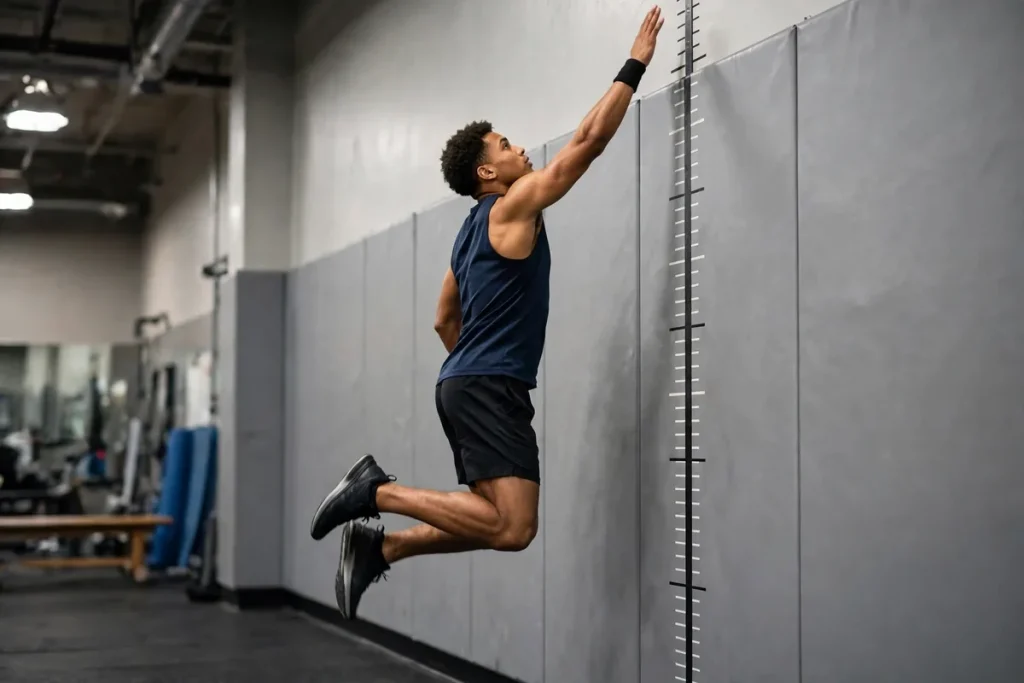

Quick Answer: The average vertical jump for an adult man is about 16-20 inches (41-51 cm); for an adult woman, about 12-14 inches (30-36 cm). Those are standing verticals — measured from a standstill with a quick dip and no run-up. Context helps: 24 inches already puts a man ahead of most recreational athletes, and 28 inches or more is elite territory outside professional sport. Below are the full rating bands, how age moves them, how to test your own number honestly at home, and what training actually adds inches. One warning before the tables: make sure you compare the same kind of jump — a running approach jump is a different, bigger number, as the third section explains.
Rating Bands: Where Your Jump Sits
These bands pull together the commonly published norms for the standing vertical jump in healthy adults. Treat them as typical ranges, not verdicts — testing methods vary (reach-and-touch against a wall vs a jump mat), and a couple of inches of measurement noise is normal.
| Rating | Men | Women |
|---|---|---|
| Excellent | 28 in and up | 24 in and up |
| Good | 24-28 in | 20-24 in |
| Above average | 20-24 in | 16-20 in |
| Average | 16-20 in | 12-16 in |
| Below average | 12-16 in | 8-12 in |
| Poor | Under 12 in | Under 8 in |
Note: every number in this table is a standing jump with a countermovement — you dip down quickly and explode up, arms swinging — and no run-up. A strict no-dip jump from a held crouch scores a few inches lower, and any run-up scores higher. That note is not fine print; it is the difference between comparing yourself fairly and chasing someone else’s inflated number.
How to read your band: the women’s bands sit lower mainly because of average differences in muscle mass and power-to-weight ratio, and the overlap between the sexes is large — a trained woman will out-jump most untrained men. Whichever band you land in, treat it as a starting coordinate, not a label. The number is trainable, which is the whole point of the last section.
How Age Changes It
Jump height is a power measurement, and power is the physical quality that fades earliest. Verticals typically peak in the late teens and twenties, when muscle mass, tendon spring and nervous-system speed all line up at once. Through school and college sport, plenty of young men test in the low-to-mid 20s without ever training specifically to jump.
After about 30, the untrained slide runs roughly an inch or two per decade. In rough terms, a man who jumps 22 inches at 22 might test around 20 at 35, 18-19 at 45 and 16-17 at 55 — without training. The causes are less mysterious than “getting old”: people lose muscle (especially the fast-twitch fibers jumping depends on), often gain a little weight for the same engine to lift, and simply stop jumping. Sprinting, hopping and landing quietly leave adult life, and the body economizes on whatever it no longer uses.
The hopeful counterweight: trained masters athletes hold far more of their vertical than the averages suggest. A 45-year-old who still squats and does plyometrics can out-jump most untrained 25-year-olds. The drop is mostly lost muscle power and lost practice, not an unavoidable tax on birthdays — which is exactly why the improvement section below works at almost any age. If you have not jumped in years, expect your first test to understate you; a few weeks of re-learning the movement often “gains” an inch or two before any fitness changes at all.
Three Different Jumps (Don’t Compare Across Them)
Most arguments about vertical jumps are really arguments about which jump was measured. There are three common versions, and they are not interchangeable:
The standing vertical (this article’s numbers). Start flat-footed, dip, and jump straight up from a standstill. This is the classic test, the one the rating bands describe, and the only fair basis for comparing two people’s numbers.
Countermovement vs no-dip. Within standing jumps, allowing the quick dip adds a little compared with a strict squat jump paused at the bottom — the stretch reflex and tendon recoil do free work for you. Most published norms, and everything in this article, use the countermovement version.
The approach (max) jump. Volleyball and basketball players take one or more steps into the jump and convert horizontal speed into height, typically adding about 4-8 inches over their standing jump. Almost every flashy “40-inch vertical” claim you have ever seen is an approach jump, a generous measurement, or both.
The NBA Draft Combine shows the confusion clearly: it measures a standing reach, a no-step vertical and a max (running) vertical — and the numbers quoted in the media are almost always the max. The NBA average max vertical sits around 28-30 inches, which is remarkable without being supernatural, while reported all-time claims run into the mid-40s. When you hear any vertical number, ask which jump produced it before you compare it to yours.
Equipment muddies things further. A Vertec (the rack of vanes athletes slap in pro gyms) reads touch height like the wall test below; jump mats estimate height from flight time and tend to flatter you slightly if you tuck your legs; phone apps vary. Pick one method and stick with it, and your progress numbers will at least be honest relative to themselves.
How to Test Yours at Home
You need a wall, a tape measure, and chalk or a strip of painter’s tape. This is the classic wall method used in gyms and school sports halls for decades:
- Warm up first — five minutes of easy movement, a few bodyweight squats and some small hops. Cold jumps understate you and risk a strain.
- Mark your standing reach: stand side-on to the wall, feet flat on the floor, and reach up as high as you can with the arm nearest the wall. Mark that point.
- Jump and touch: from the same spot, dip and jump as high as you can, touching the wall at the very top. Mark that point.
- Measure between the marks. The difference between your jump touch and your standing reach is your vertical jump.
Take three attempts with a minute or so of rest between them and count the best one — that matches how formal testing works. A few honesty details: no tiptoes on the reach (flat feet, shoulder against the wall), chalk your fingertips if the touch marks are hard to read, and test on a hard, flat surface in the shoes you would train in. The two classic errors are an exaggerated standing reach (which steals inches from your score) and drifting away from the wall mid-jump (which does the same). Test fresh, not after a workout.
Write the result down with the date and your body weight — you will want the baseline when you retest in 8-12 weeks. And if you want a bodyweight base to build from, our calisthenics workout covers the squats, hinges and core work that support jumping.
How to Add Inches
A vertical jump is force produced quickly. Effective training works in that order: build the force, then teach it to fire fast, then polish the technique.
Strength first. Squats, deadlift patterns, lunges and hip thrusts make you forceful against the ground — and ground force is the raw material of jump height. Two strength sessions a week, progressing gradually, form the foundation. New to lifting? Goblet squats and bodyweight progressions count; the movement pattern matters more than the implement.
Plyometrics second. Once a base exists, plyometrics teach fast force: pogo hops for springy ankles, box jumps for safe full-effort jumping (jump up, step down — don’t jump down), and small sets of tuck jumps. Depth jumps are an advanced tool, earned after months of basics, not a week-one experiment. Keep plyometric sets short and fresh — 3-5 quality reps with full rest, and stop when your jump height visibly drops. This is power practice, not conditioning.
Technique freebies. Your arm swing is worth roughly 10% of your jump — swing hard and time it with the dip. Dip fast and don’t pause at the bottom (the pause leaks the stretch reflex), drive your knees up, and reach tall at the top. These cost nothing and often appear in the very first session.
A simple week that combines all three: strength on Monday, plyometrics and technique for 20 minutes on Wednesday, strength again on Friday, with at least one true rest day between hard leg sessions. Retest every 8-12 weeks, not every week — jump height moves in small steps, and daily testing mostly measures your fatigue.
Realistic expectations: beginners commonly add 2-4 inches in 3-6 months of consistent strength plus plyometric work. Losing excess body fat helps directly and mechanically — it is less mass for the same engine to launch, and jump height responds quickly to it. Even humble conditioning plays a supporting role: our guide to how many jumping jacks to burn 100 calories is the entry-level end of the same power-and-bodyweight story. Two safety rules protect the whole project: land softly (quiet feet, knees tracking over toes, never collapsing inward), and build volume gradually — tendons adapt more slowly than muscles, and cranky knees or an irritated Achilles tendon are the classic price of doing week six’s program in week one. Sharp pain is a stop signal, not a toughness test.
Frequently Asked Questions
What is the average vertical jump for a man?
About 16-20 inches (41-51 cm) for a standing countermovement jump. Trained recreational athletes usually sit in the low-to-mid 20s.
What is the average vertical jump for a woman?
About 12-14 inches (30-36 cm) standing. Around 20 inches is good, and 24 inches or more is excellent for women.
Is a 30-inch vertical good?
Excellent — a 30-inch standing vertical puts you in the top few percent of recreational athletes. Most regular gym-goers never touch it, and it would score respectably in many college programs.
What is the average NBA vertical jump?
Around 28-30 inches on the max (running) vertical test at the NBA Draft Combine. The widely quoted 40-inch figures are all-time outliers and reported claims, not averages.
Can anyone increase their vertical?
Yes — 2-4 inches in a few months is typical for beginners who combine strength training with plyometrics and technique work. Genetics set the ceiling, but almost nobody is training near theirs.