
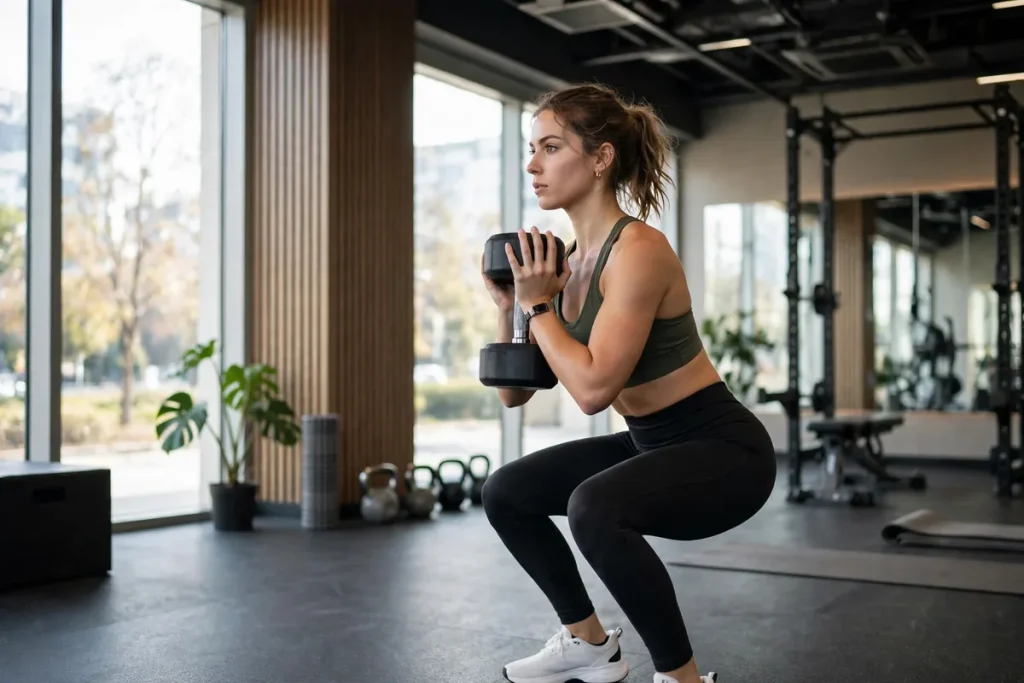

Quick Answer: If you only train one body part this week, make it your legs. A complete lower body workout trains four movement patterns — squat, hinge, lunge and calf raise — in about 45 minutes, once or twice a week. Your legs hold your body’s biggest muscles (glutes, quads and hamstrings), so leg day is also your biggest strength-training calorie burn. This guide gives you the gym workout, a no-equipment home version, the calories it burns, and a gentler routine for seniors.
Good news: you do not need a wall of machines or a two-hour session. Six well-chosen exercises, honest effort, and a little more weight over time will cover everything below the waist — and the workouts below scale from a first-timer with one dumbbell to a senior with a kitchen chair.
Why do legs get a whole day of their own? Because they are half your body. Training them hard in one focused session — rather than sprinkling two leg exercises into every workout — lets you give the big muscles the volume and the recovery they actually need, and it leaves your upper-body days free for pushing and pulling.
The Muscles
Before the workout, a quick map. Four muscle groups do almost all the work in your lower body, and every exercise in this guide exists to train at least one of them.
- Glutes. The biggest muscle in your body. The glutes extend the hip — the motion that stands you up from a chair and powers you up stairs. Bridges, hip thrusts and hinges train them hardest.
- Quadriceps. The four muscles down the front of your thigh. They straighten the knee, which is why they star in squats, lunges and the leg press.
- Hamstrings. The back of your thigh. They bend the knee and help extend the hip, so hinges like the Romanian deadlift and leg curls are their home turf.
- Calves. Really two muscles in one: the gastrocnemius, the visible upper calf worked with a straight knee, and the soleus underneath it, worked with a bent knee. Raises in both positions cover both.
- Adductors and core. Your inner-thigh adductors stabilize your knees and pelvis during single-leg work, and your core braces through every squat and hinge — support crew rather than stars, but never off duty.
A simple rule of thumb ties it together: front of the leg = squat patterns, back of the leg = hinge patterns, and single-leg work = balance, plus a fix for the left-right strength gaps almost everyone has.
Every workout below is just those patterns in different outfits: a squat pattern, a hinge pattern, a single-leg pattern and a calf pattern. Learn the patterns once and you can build a leg day anywhere — a full gym, a living room, or a hotel room with a chair.
The Leg Day Workout (Gym or Dumbbells)
This is the main session, and it works in a full gym or with a single pair of dumbbells at home: the goblet squat is the dumbbell-friendly squat, and every other exercise needs nothing more than weight you can hold. Warm up with 3-5 minutes of easy cycling or brisk walking and one light set of squats, then work through the table top to bottom.
| Exercise | Sets x Reps | Rest | Main target |
|---|---|---|---|
| Goblet squat (or barbell back squat) | 3×8-10 | 90 sec | Quads/glutes |
| Romanian deadlift | 3×10 | 90 sec | Hamstrings/glutes |
| Reverse lunge | 2×10 per leg | 60 sec | Quads/glutes/balance |
| Hip thrust or glute bridge | 3×12 | 60 sec | Glutes |
| Standing calf raise | 3×15 | 45 sec | Calves |
| Dead bug or plank | 2×40 sec | — | Core finisher |
Three form cues fix most leg day mistakes:
- Squat: keep your whole foot planted, heel included, and let your knees track out over your toes instead of caving inward.
- Hinge: push your hips back like you are closing a car door with your backside — soft knees, flat back, weight close to your legs.
- Lunge: keep your torso tall and your front knee steady; most of your weight stays in the front leg.
- Breathing: take a breath and brace your midsection before each hard rep, then exhale as you stand up. A braced trunk protects your back on squats and hinges alike.
Choosing the weight: pick a load where the last 2 reps of each set feel genuinely hard while your form stays clean. When every set starts to feel easy, add a little weight next time — a couple of pounds, or the next dumbbell up. That slow, steady increase is progressive overload, and it is the whole engine of getting stronger.
One more thing about the flow: do the exercises in the order listed. The squat comes first because it is the heaviest, most technical lift, and it deserves fresh legs and a fresh brain. The core finisher comes last because a tired core halfway through squats helps nobody. From warm-up to finisher, the whole session takes about 45 minutes.
No-Equipment Home Version
No weights? No problem. This version trains the same four movement patterns with bodyweight only, and it is harder than it looks — especially with the tempo trick below.
| Exercise | Sets x Reps |
|---|---|
| Bodyweight squat | 3×15 |
| Split squat (rear foot on floor) | 2×10 per leg |
| Glute bridge (1-second squeeze on top) | 3×15 |
| Wall sit | 3×40 seconds |
| Standing calf raise on a step | 3×15 |
Between sets, practice single-leg balance: stand on one foot for 20-30 seconds per side while you rest. It sounds like nothing; your ankles and adductors will disagree. And to make bodyweight work hard enough, slow the lowering phase of every rep to a full 3 seconds. Lowering slowly removes momentum and turns an easy 15-rep squat into real work.
When the home version starts to feel easy, you have three honest progressions before you ever need to buy a weight: slow the lowering phase down to 5 seconds, pause for 2 seconds at the hardest point of each rep, or load a backpack with books for the squats and bridges. A backpack of paperbacks is a perfectly respectable dumbbell.
Calories Burned in a Leg Day
Vigorous strength training — short rests, big compound lifts — runs at about 6 METs. Using the standard formula (kcal per minute = METs x 3.5 x body weight in kg / 200), a 45-minute session burns roughly:
| Body weight | Calories in 45 minutes |
|---|---|
| 120 lb (55 kg) | 260 kcal |
| 154 lb (70 kg) | 331 kcal |
| 185 lb (85 kg) | 402 kcal |
What about the famous “afterburn”? EPOC — the extra energy your body spends recovering — is real but modest: roughly 6-15% on top of the session’s burn, spread over the following hours. That is tens of bonus calories, not hundreds. Leg day’s real calorie value is the session itself, plus the muscle it builds — tissue your body pays to maintain every single day. For the full-week picture, a leg day slots neatly into our beginner workout plan alongside upper-body and walking days.
Leg Exercises for Seniors
Leg strength is independence. It is what gets you out of a chair, up the stairs, and back on your feet after a stumble — which is why this gentler routine trains exactly those daily-life movements.
- Sit-to-stand, 2×8-10. From a sturdy chair, stand up fully, then sit back down with control. This is the single most useful leg exercise for daily life.
- Supported heel raises, 2×12. Holding a counter or the back of a chair, rise up onto your toes, then lower slowly.
- Low step-ups, 2×6 per leg. Use a 4-6 inch step with a rail or counter within reach. Step up, step down, switch sides.
- Seated knee extensions, 2×10. Sitting tall, straighten one knee until the leg is level, hold a second, and lower with control.
Safety framing, plainly: keep balance support within reach for every standing exercise, move slowly, and stop on sharp pain — muscle effort is fine, joint pain is a stop sign. And check with your doctor first if you have joint replacements, arthritis or balance problems.
How often? Two or three short sessions a week suit most older adults better than one long one, and daily walking pairs beautifully with this routine — the strength work makes the walking easier, and the walking keeps the joints happy between sessions. Start with one set of everything if two feels like a lot; consistency beats intensity at every age.
How Often, and the Soreness Question
Train your lower body once or twice a week, and leave at least 48 hours before training the same muscles again — muscles actually get stronger during recovery, not during the workout itself. One session a week builds and maintains for most beginners; two, with a couple of days between them, is the sweet spot once you are used to it.
And the soreness everyone asks about: DOMS (delayed-onset muscle soreness) is the dull ache that appears 24-72 hours after a new or harder workout. It is completely normal, worst in the first week, and it fades as the body adapts over 2-3 weeks of repeating the routine. But sharp joint pain is not DOMS — if a knee, hip or ankle hurts sharply, back off that exercise, and get it checked if it lingers.
If you train legs twice a week, vary the emphasis: make one day heavier (the gym table, lower reps, longer rests) and the other lighter (the home table, slower tempos, shorter rests). Same patterns, different stress — that is how lifters keep progressing for years without beating up the same joints the same way twice.
If gyms simply are not your thing, our calisthenics workout builds the same patterns with bodyweight only.
Frequently Asked Questions
How often should I do a lower body workout?
Once or twice a week, 48 hours apart.
Is leg day good for weight loss?
Yes, it trains the biggest muscles and burns roughly 260-400 kcal in 45 minutes.
Can I do a leg workout at home without equipment?
Yes, the home table above covers every pattern.
Why are my legs so sore after leg day?
DOMS, normal for 24-72 hours when training is new or harder.
If I can only pick one leg exercise?
The squat pattern (goblet or bodyweight squat) — it trains quads, glutes and core together.
The bottom line: a complete lower body workout is four movement patterns — squat, hinge, lunge and calf raise — trained for about 45 minutes, once or twice a week. Pick the version that matches your equipment and your life today: the gym table if you have weights, the home table if you do not, and the seniors’ routine if balance and joints call for a gentler start. Keep the form cues in mind, rest at least 48 hours between leg days, and add a little weight, a slower tempo or an extra rep whenever a session starts to feel easy. That is the whole system — simple on paper, and it works for decades.
How do you know it is working? Write down your weights and reps. When the numbers creep up month over month — and stairs start feeling suspiciously easy — the plan is doing its job. Strength you can measure beats soreness you can feel as a progress marker, every time.
Note: calorie figures are estimates from standard MET values for vigorous resistance training; your actual burn varies with effort, rest periods and body composition.

Pingback: StairMaster Calories Burned: 30 & 60 Minutes by Weight