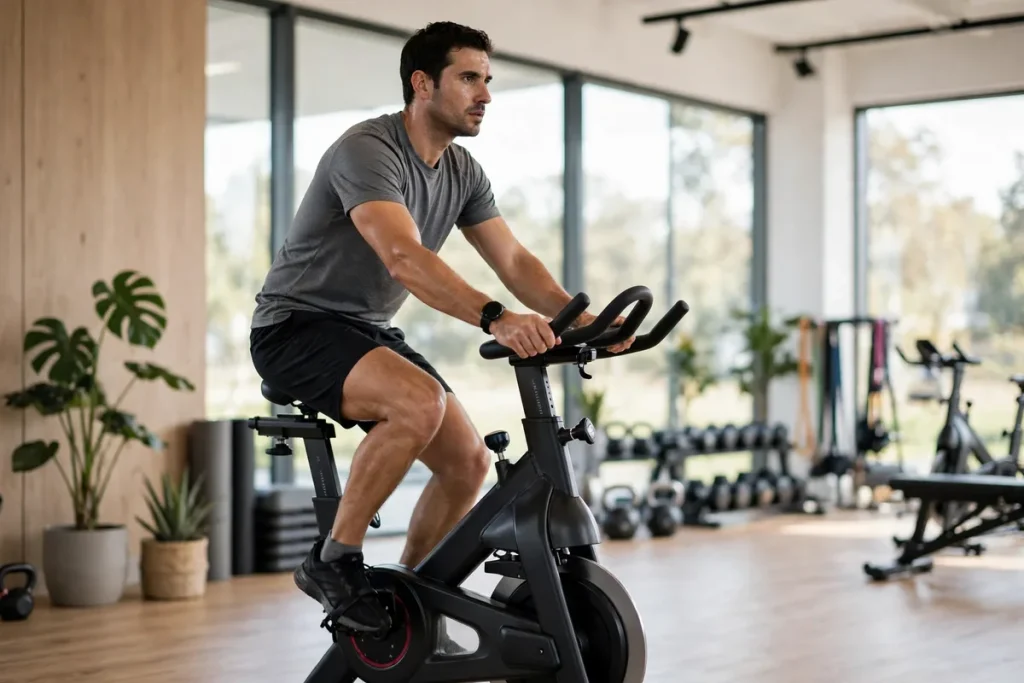

Quick answer: stationary bike calories burned depend mostly on the watts you hold and the body you bring. At a moderate effort (about 100 watts, 6.8 METs), a 154 lb (70 kg) rider burns roughly 250 kcal in 30 minutes and about 500 kcal in an hour. And on a bike, the honest dial is watts, not the “level” number — because level 8 on one bike can be level 12 on another, while 100 watts is 100 watts everywhere.
That is what makes the stationary bike such a gift for honest calorie math. Runners argue about pace, swimmers about stroke efficiency, but a bike with a power readout tells you the actual work rate, second by second. Combine that with your weight and the clock, and the estimate stops being a guess.
The Numbers by Weight
Here is the moderate-effort table — about 100 watts, the pace most people settle into once they are warmed up: breathing hard, conversation possible in short sentences, legs working but sustainable. The math is the standard MET formula: kcal per minute = METs × 3.5 × body weight in kg ÷ 200.
| Body weight | 30 minutes | 60 minutes |
|---|---|---|
| 120 lb (55 kg) | 196 | 393 |
| 154 lb (70 kg) | 250 | 500 |
| 185 lb (85 kg) | 303 | 607 |
| 220 lb (100 kg) | 357 | 714 |
Two things to notice. First, weight matters, but less than on foot: the saddle carries you, so a heavier rider burns more mainly because bigger legs do more absolute work — there is no body-weight lifting against gravity like running or stair climbing. Second, these are moderate numbers. The watts table below is where the burn really gets decided.
Watts Are the Whole Story
The Compendium of Physical Activities prices stationary cycling in power bands, and the spread is dramatic. Same rider, same bike — the only thing that changes is the watts:
| Effort | Watts | METs | kcal per hour (154 lb) |
|---|---|---|---|
| Light spin | Under 90 W | 5.5 | 404 |
| Moderate | 90–100 W | 6.8 | 500 |
| Vigorous | 101–160 W | 8.4 | 617 |
| Hard | 161–200 W | 10.5 | 772 |
| Very hard | 200 W+ | 12.5 | 919 |
Doubling your power output more than doubles your calorie burn — from a light spin at 404 an hour to a very hard effort at 919. That is why two people can both say “I did 30 minutes on the bike” and have done completely different workouts.
Here is the liberating part: watts are simply resistance × cadence. You can reach the same watts by spinning faster against less resistance, or grinding slower against more. Your heart and your legs care about the product, not the recipe. Riders with cranky knees usually prefer the high-cadence, low-resistance route; riders who like the feel of a climb choose the grind. The calories do not care which you pick.
If your bike shows no watts — many home bikes do not — use effort as your proxy. Light spin: you could chat normally. Moderate: short sentences. Vigorous: a few words at a time. Hard: talking is basically off the menu. Match the band honestly and the table still works.
A note on heart rate, since many riders train by it: heart rate is a decent effort gauge but a laggy one — it drifts upward over a long ride even at constant watts (heat, dehydration and fatigue all push it up), and it takes a minute or two to catch up when you change the resistance. Watts respond instantly and mean the same thing on day one and day ninety. If your bike offers both, steer by watts and let heart rate be the background check.
Why the Console Number Runs High
Now the bad news about the glowing number on the console. Most bikes estimate calories from a default rider — often somewhere around 150–175 lb — run through a generous formula. If you weigh less than the default, or your bike’s formula is one of the optimistic ones, the display happily credits you with work you did not do. Independent checks of gym equipment commonly find calorie readouts running about 10–30% optimistic.
The fix is boring and effective: use the by-weight table in this article for planning — your deficit, your meal decisions, your weekly targets — and let the console do the job it is actually good at, which is motivation during the ride. It is the same trap as the StairMaster’s handrails, where the machine keeps counting full price while your arms quietly pay part of the bill — we broke that down in our guide to StairMaster calories burned. Machines flatter; physics does not.
One more wrinkle: some consoles count the calories you would have burned sitting still (your resting metabolism) inside the workout total, which pads the number further. The tables here count the ride itself. When you log exercise in a food diary, the conservative move is to log the table value — or even a touch under it — rather than the console’s celebration.
Upright vs Recumbent vs Outdoor
Upright or recumbent? At equal watts, the burn is near-identical — physics wins, and the flywheel cannot tell what shape of seat you are sitting on. The recumbent trades a little core involvement for comfort and back support, which makes it the better choice for longer sessions, heavier riders and sore backs. The upright engages a bit more trunk and feels closer to a real bike. Pick the one you will still be using in March.
Outdoor riding at the same power costs similar energy while you are actually pedaling — but real rides include coasting down hills, soft-pedaling to corners and stopping at lights, none of which burn much. That is why an indoor hour so often out-burns a “same length” outdoor ride on the clock: indoors, the clock and the work run together. If you want a machine that adds the upper body back into the equation, the other great low-impact option is rowing — see how to use a rowing machine for its numbers.
How the Bike Stacks Up
For context at 154 lb: a moderate bike hour (about 500 kcal) sits comfortably in the middle of the gym’s burn league. Thirty minutes of moderate rowing costs about 257 kcal — very close to the bike’s moderate 250. The StairMaster beats both per minute (about 331 kcal per 30 minutes) but also beats up your legs and patience faster. Brisk walking is gentler at roughly 250–300 kcal an hour. The bike’s real advantage is not the top number — it is how repeatable its middle number is: no impact, no weather, no traffic, and a workload you can set to the watt.
A Simple 30-Minute Burn Session
Here is a session that uses the watts bands honestly instead of one heroic gear you cannot repeat:
- 5 minutes easy spin — under 90 W, just warming the legs up.
- 5 rounds of 3 minutes moderate + 1 minute light — moderate means 90–110 W (short-sentence effort), light means back under 90 W.
- 5 minutes cool-down — easy spin, let the breathing settle.
At 154 lb that lands around 230–260 kcal, and — this is the point — it is repeatable three or four times a week. Consistency beats the heroic once-a-month hour every time, because four honest 250s a week out-burn one miserable 600 followed by six days of sore legs and good intentions. As the weeks pass, progress the session by nudging the moderate blocks up by about 5 watts, or adding a sixth round — small, boring, effective.
Frequently Asked Questions
How many calories does a stationary bike burn in 30 minutes?
About 250 kcal at a moderate effort (around 100 watts) for a 154 lb rider. By weight, moderate 30-minute rides run from about 196 kcal at 120 lb to about 357 kcal at 220 lb.
Does resistance or speed burn more calories?
Neither one alone — watts decide, and watts are the product of resistance and cadence. Spinning faster against less resistance and grinding slower against more can produce exactly the same watts, and the same burn.
Is a stationary bike good for bad knees?
It is one of the kindest cardio options there is: no impact, and the load is smooth through the whole pedal stroke. Set the seat high enough that your knee keeps a slight bend at the bottom of the stroke, and let pain, not pride, set the resistance.
Stationary bike or treadmill for calories?
At matched effort the burn is similar. The bike wins on joints, quiet and the ability to read or watch something while you ride; the treadmill wins on bone loading and needs no setup beyond your shoes.
How long does it take to burn 500 kcal on a stationary bike?
About 60 minutes at a moderate effort if you weigh 154 lb, or roughly 40 minutes at a hard 161–200 W effort. Heavier riders get there sooner; lighter riders need a little longer or a few more watts.
The bottom line: on a stationary bike, watts are the truth and time is the multiplier. Hold a power you can repeat, let your weight set the rate from the table, and ignore the console’s flattery. Do that three or four times a week and the bike quietly becomes one of the most reliable calorie tools in the building.