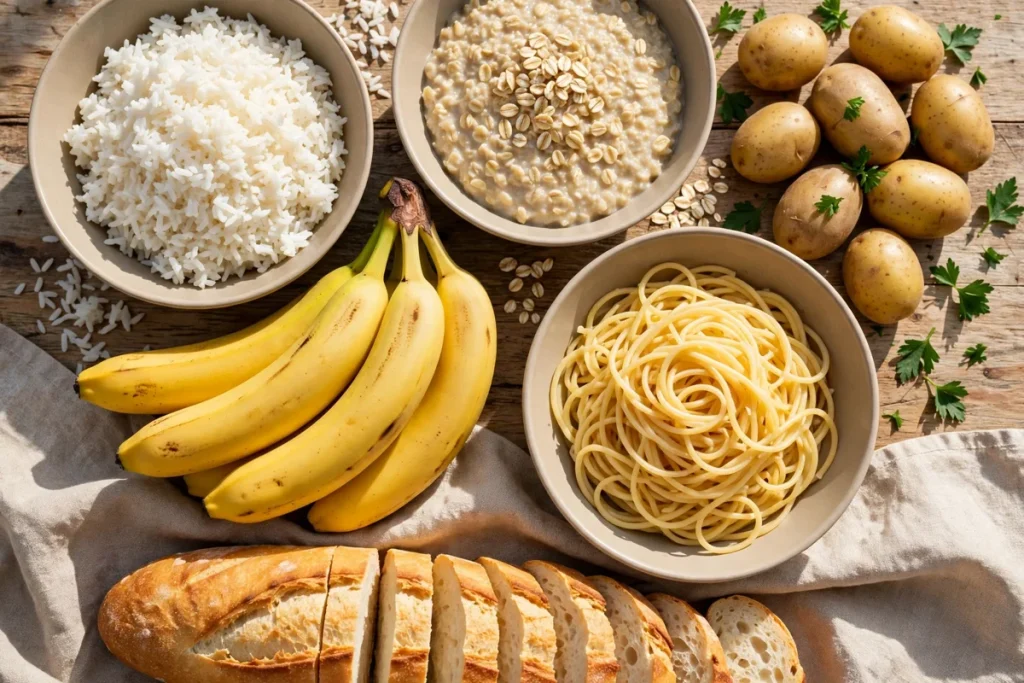

If you want energy without much fat, high carb low fat foods are the obvious place to look. A food counts for this list when most of its calories come from carbohydrate and its fat stays very low — roughly under 2 g of fat per 100 g for the strict staples below. People reach for these foods for endurance fuel, for high-carb low-fat diets, and because they are easy to digest before training. Every figure below is per 100 g, cooked where the food is normally eaten cooked, from standard reference values.
What counts as high carb, low fat?
The rule used here is simple: carbohydrate supplies most of the calories, and fat stays at or under about 2 g per 100 g. That keeps the list honest — a few popular picks sit just over the line, and they are marked as such instead of being smuggled in. Three foods in this list — white bread, pretzels and rice cakes — are over the strict line, and oats, at around 7 g of fat per 100 g dry, does not make the strict list at all (see the note near the end).
Grains and starchy foods
- White rice (cooked) — 130 calories, 28 g carbs, 0.3 g fat, 2.7 g protein. The classic endurance staple: cheap, gentle on the stomach, and almost fat-free.
- Spaghetti (cooked) — 131 calories, 25 g carbs, 1.1 g fat, 5 g protein. Pasta is a pre-race favourite for a reason: dense carbs, very little fat.
- Potatoes (boiled) — 77 calories, 17 g carbs, 0.1 g fat, 2 g protein. One of the lowest-fat carb sources there is, and far more filling per calorie than bread.
- Sweet potato — 86 calories, 20 g carbs, 0.1 g fat, 1.6 g protein. Adds vitamin A and fibre to the same low-fat profile; our sweet potato fries guide shows how cooking method changes the calories.
- Corn — 96 calories, 19 g carbs, 1.4 g fat, 3.3 g protein. Sweet, filling, and still under the fat line.
- White bread — 265 calories, 49 g carbs, 3.2 g fat, 9 g protein. Honest note: at 3.2 g of fat per 100 g it sits just over the strict line — low-ish, not the lowest.
- Pretzels — 380 calories, 80 g carbs, 2.6 g fat, 10 g protein. Very carb-dense, but again just over the line at 2.6 g of fat, and usually salty.
- Rice cakes — 387 calories, 81 g carbs, 2.8 g fat, 7 g protein. Light to eat but dense per 100 g, and 2.8 g of fat puts them just over the strict line too.
Fruits
- Banana — 89 calories, 23 g carbs, 0.3 g fat, 1.1 g protein. The portable endurance snack; see our banana calories guide for sizes.
- Mango — 60 calories, 15 g carbs, 0.4 g fat, 0.8 g protein. Sweet and light, with very little fat.
- Dates — 282 calories, 75 g carbs, 0.2 g fat, 1.8 g protein. The most carb-dense fruit on this list by far — nature’s energy gel.
- Apple — 52 calories, 14 g carbs, 0.2 g fat, 0.3 g protein. Low in everything except water and crunch; a lighter, fresher option.
Legumes and vegetables
- Black beans (cooked) — 132 calories, 23 g carbs, 0.5 g fat, 9 g protein. The best protein return on this list.
- Lentils (cooked) — 116 calories, 20 g carbs, 0.4 g fat, 9 g protein. Cheap, filling, and nearly a tenth protein by weight; try our lentil soup for an easy way to eat them.
- Peas — 81 calories, 14 g carbs, 0.4 g fat, 5 g protein. A green vegetable that eats like a starch.
The full table: all 15 foods per 100 g
| Food | Calories | Carbs | Fat | Protein |
|---|---|---|---|---|
| White rice (cooked) | 130 | 28 g | 0.3 g | 2.7 g |
| Spaghetti (cooked) | 131 | 25 g | 1.1 g | 5 g |
| Potatoes (boiled) | 77 | 17 g | 0.1 g | 2 g |
| Sweet potato | 86 | 20 g | 0.1 g | 1.6 g |
| Corn | 96 | 19 g | 1.4 g | 3.3 g |
| White bread | 265 | 49 g | 3.2 g | 9 g |
| Pretzels | 380 | 80 g | 2.6 g | 10 g |
| Rice cakes | 387 | 81 g | 2.8 g | 7 g |
| Banana | 89 | 23 g | 0.3 g | 1.1 g |
| Mango | 60 | 15 g | 0.4 g | 0.8 g |
| Dates | 282 | 75 g | 0.2 g | 1.8 g |
| Apple | 52 | 14 g | 0.2 g | 0.3 g |
| Black beans (cooked) | 132 | 23 g | 0.5 g | 9 g |
| Lentils (cooked) | 116 | 20 g | 0.4 g | 9 g |
| Peas | 81 | 14 g | 0.4 g | 5 g |
Why athletes use them — and the honest cautions
Carbohydrate is the body’s main fuel, stored as glycogen in muscle and liver — which is why endurance athletes load up on rice, pasta and potatoes before long sessions. But high carb low fat is not automatically healthy: whole foods like potatoes and beans beat refined ones like pretzels, which bring salt and little else. Protein still has to come from somewhere, and most foods here are low in it — beans and lentils help, but pair these staples with a protein source at meals. And if you manage blood sugar, be careful with big refined-carb portions; talk to your doctor about personal targets. For how carb quality matters, see our good carbs guide.
The borderline note: what about oats?
Oats are often assumed to belong on this list, but dry oats carry about 66 g of carbs and around 7 g of fat per 100 g (about 389 calories and 17 g of protein) — far over the strict line — so they sit outside it. They are still a good food; they are just not a low-fat one.
The simplest takeaway: if you want carbs with almost no fat, start with rice, potatoes, bananas and beans — whole, cheap and hard to get wrong.
What foods are high in carbs and low in fat?
Cooked white rice, potatoes, pasta, bananas, beans and lentils are the classics. White rice has 28 g of carbs and just 0.3 g of fat per 100 g; boiled potatoes have 17 g of carbs and 0.1 g of fat.
Are bananas high carb low fat?
Yes. A banana has about 23 g of carbs and only 0.3 g of fat per 100 g, for 89 calories — a textbook high-carb, low-fat food.
Is rice high carb and low fat?
Yes. Cooked white rice has 28 g of carbs and 0.3 g of fat per 100 g, at 130 calories, making it one of the lowest-fat carb staples there is.
Is a high carb low fat diet healthy?
It can be, but it depends on the foods you choose. Whole foods like potatoes, beans and fruit beat refined picks like pretzels, and you still need enough protein — beans and lentils help. If you manage blood sugar, talk to your doctor about portion sizes.
What fruit is highest in carbs and lowest in fat?
Dates: 75 g of carbs and only 0.2 g of fat per 100 g, at 282 calories. Among fresh fruit, bananas are the highest-carb common choice at 23 g of carbs and 0.3 g of fat per 100 g.