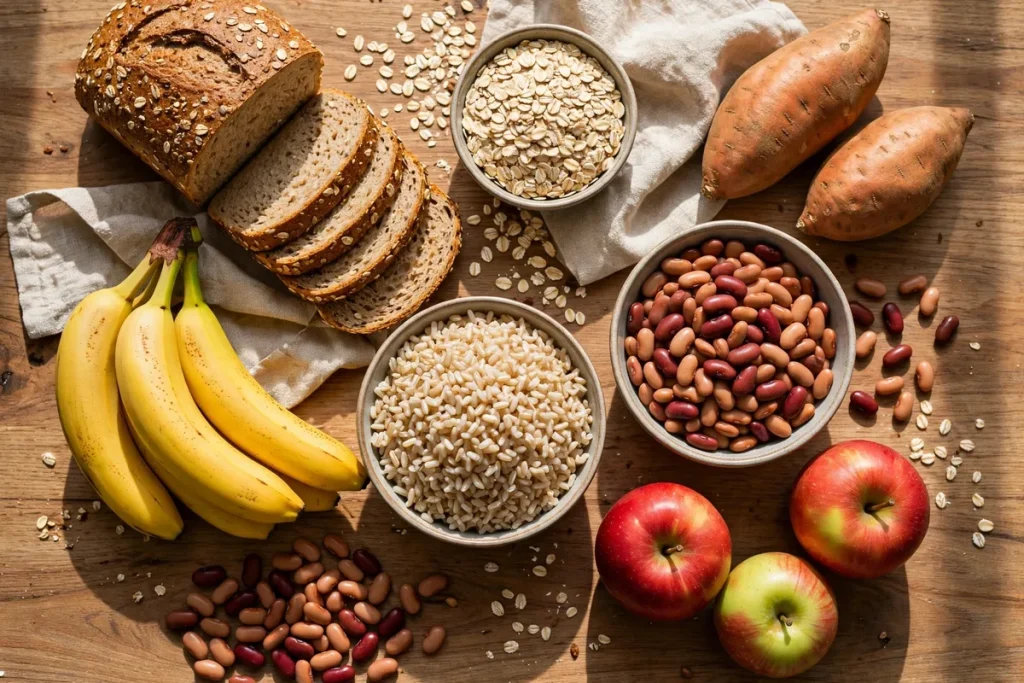

Good carbs are not a separate food group — they are simply carbohydrates that arrive the way nature packaged them: with their fiber, water, vitamins and minerals still attached. Carbohydrates are your body’s preferred fuel, providing 4 kcal per gram, and whether a carb helps you or mostly just adds calories comes down to two things: fiber and processing.
Whole, fiber-rich carbs — oats, beans, fruit, whole grains — digest slowly, keep you full, and deliver nutrients along with their energy. Refined, fiber-stripped carbs — white bread, soda, candy — digest in minutes, spike and crash your energy, and are famously easy to overeat. That is the entire good-versus-bad story in one paragraph; everything below is the useful detail.
What Do Carbohydrates Do for the Body?
Before judging carbs, it helps to know what they are actually for. Carbohydrates have five main jobs in your body, and none of them is an optional extra — they are core operations that run every single day.
Energy for everything you do. Most of the carbohydrate you eat is broken down into glucose, which travels in your blood to muscles, organs and every cell that needs fuel. Glucose is the body’s default energy currency: quick to release, easy to transport and usable by every tissue you own. Climbing stairs, concentrating in a meeting, chasing a toddler — all of it runs largely on carbohydrate energy.
Brain fuel. Your brain is a glucose specialist. It runs almost entirely on glucose and uses roughly 120 g of it a day — around a fifth of a typical day’s energy, from an organ that is only about 2% of your body weight. That is why low blood sugar makes thinking foggy, and why exams, long drives and deep-focus work feel like carb-burning activities: in a real sense, they are.
Sparing protein. Protein has construction work to do — building and repairing muscle, enzymes, hormones and immune cells. When you eat enough carbohydrate, protein is left alone to do that building. When carbs run very low for a long stretch, the body starts converting amino acids into glucose instead — an expensive way to make fuel, and one reason very-low-carb diets need care to protect muscle.
Exercise fuel, stored as glycogen. Glucose you do not need right away is stored as glycogen — roughly 400-500 g of it packed into your muscles and liver when the tank is full. Glycogen powers harder efforts: lifting, sprinting, hills and the final miles of a long run all draw on it. It is why athletes talk about carb-loading, and why a hard workout the day after a very low-carb day can feel strangely heavy.
Digestion and gut health. Fiber is a carbohydrate too — the kind your own enzymes cannot break down. It adds the bulk that keeps your gut moving, slows the absorption of the other carbs in the same meal, and feeds the bacteria in your colon, which return the favor by producing compounds that support gut and metabolic health. A diet low in whole-food carbs is almost always low in fiber — and digestion notices.
Put together, carbs are not a garnish on the diet. They are the fuel system, the brain’s supply line, the protector of your protein, the exercise tank and the gut’s housekeeping service in one nutrient family. The good-versus-bad question is really about which forms deliver those jobs best.
The 3 Types of Carbohydrates
Every carbohydrate on your plate belongs to one of three families. They differ mainly in how quickly they turn into glucose — and, in fiber’s case, whether they turn into glucose at all.
| Type | What it is | Found in |
|---|---|---|
| Sugars | Simple and fast: one or two sugar units, absorbed quickly | Fruit, milk, table sugar, honey, syrups |
| Starches | Long chains of glucose that take longer to unpack | Grains, potatoes, corn, beans, peas |
| Fiber | Chains your enzymes cannot break; passes through and feeds gut bacteria | Vegetable and fruit skins, whole grains, legumes, nuts and seeds |
Notice that sugar is not one story. The sugar in an apple arrives wrapped in fiber and water that slow it right down; the sugar in a soda arrives alone and is absorbed within minutes. The family matters — but so does the company a carb keeps. Keep that in mind as we sort the good from the not-so-good.
You will also hear carbs divided into simple and complex. That is roughly the same map: sugars are the simple ones, while starches and fiber are the complex ones. The label matters less than the behavior — how fast the carb digests, and what arrives with it.
Good Carbs: The List That Actually Helps You
So which carbs earn the label of good carbs? The five groups below share the same profile: minimally processed, rich in fiber, and carrying useful nutrients for every calorie they bring. There is nothing exotic on the list — which is rather the point.
| Food group | Examples | Why it is good |
|---|---|---|
| Whole grains | Oats, brown rice, whole-wheat bread, quinoa | Fiber plus B vitamins and minerals; slower, steadier energy than refined grains |
| Legumes | Beans, lentils, chickpeas | Fiber plus plant protein; among the most filling foods per calorie there are |
| Fruits | Apples, bananas, berries, oranges | Fiber, vitamin C, potassium and water in a naturally portioned package |
| Starchy vegetables | Sweet potatoes, corn, peas | Fiber and slow-release energy, plus micronutrients such as vitamin A |
| Dairy | Milk, plain yogurt | Lactose for energy, plus protein and calcium — choose unsweetened versions |
Fiber is the thread running through the whole table. Most adults get only about half the fiber they need, and good carbs are how you close that gap with food instead of supplements. Our ranked guide to the highest fiber foods shows the grams per serving for 25 foods — most of them the very same foods in this table.
A practical test at the supermarket shelf: could this food have been eaten, in roughly this form, a hundred years ago? Oats, beans, fruit and potatoes pass easily. Most packaged snack cakes and sugary cereals do not — which leads neatly to the next list.
Carbs to Limit (Not Fear)
The carbs worth limiting are the refined ones: grains stripped of their bran and germ, and sugars separated from any food structure. White bread, pastries, sugary drinks, candy and most packaged snacks share the same traits — fast glucose, little or no fiber, few nutrients, and portions designed to be effortless to overeat.
The classic example is fruit versus juice. A whole orange holds roughly 12 g of sugar wrapped inside fiber, and it takes a few minutes to eat. Juice four oranges and you get all their sugar with almost none of the fiber and almost none of the fullness — and you can drink it in thirty seconds. Same fruit, similar sugar on paper, completely different effect on your appetite and blood sugar. Fiber changes what a food does.
Limit is the right word, though — not fear. A slice of birthday cake, or a white-bread sandwich inside an otherwise fiber-rich week, is a rounding error. The problem pattern is when refined carbs become the default base of every meal and snack, because then the fiber, protein and micronutrients they displaced are missing every single day.
A useful middle rule: treat refined carbs as guests, not residents. If they show up occasionally, enjoy them without a second thought. If they are quietly structuring every plate, change one default at a time — white rice to brown, soda to sparkling water, a pastry breakfast to oats — and let the swaps accumulate.
Are Carbs Good for You? The Honest Answer
Yes — in the right forms and amounts, carbohydrates are genuinely good for you. They are the main fuel of the brain and working muscles, the vehicle for nearly all the fiber in the diet, and the backbone of the foods — vegetables, fruits, legumes, whole grains — that show up again and again in the eating patterns linked with the best long-term health.
The other honest half: carbs do not cause fat gain by themselves — a calorie surplus does. People gain weight on high-carb diets and on low-carb diets, and lose weight on both, because the deciding factor is total energy, not which nutrient it arrived as. Low-carb diets work when they create a deficit — usually by removing the easy-to-overeat refined foods and raising protein — not by magic, and not because carbohydrate is toxic.
One group clearly does better with more carbs: very active people. If you train hard most days, carbohydrate is the limiting fuel for quality sessions, and chronically under-eating it shows up as flat workouts and slow recovery. Sedentary people need less; athletes need more; most of us sit somewhere in the middle — which is exactly where the standard guidance aims.
How Many Carbs Should You Eat?
The accepted range used by nutrition authorities is 45-65% of daily calories from carbohydrate. On a 2,000 kcal diet, that works out to about 225-325 g of carbs a day. Athletes and very active people often thrive toward — or even above — the top of the range. Some people feel and perform better lower down, and that can work too, as long as protein and fiber get deliberate attention so a lower carb total does not crowd them out.
It also does not have to be identical every day. Many active people eat more carbs on training days and fewer on rest days, and do perfectly well. What matters is the weekly pattern, and whether your energy, training and digestion feel right on it. Your own feedback is data: steady energy, normal hunger between meals and decent training sessions mean the level is about right.
If you want the number for your own calorie target instead of a generic 2,000 kcal example, our guide to how to calculate macros turns your calories into personal gram targets in four steps. And for how carbs fit alongside protein, fats and the other food groups on an actual plate, see our explainer on what is a balanced diet.
5 Quick Facts About Carbohydrates
Five facts worth keeping, all in one place:
- Every gram of carbohydrate provides 4 kcal — exactly the same as a gram of protein. Fat, at 9 kcal per gram, is the concentrated one.
- Fiber is a carbohydrate your body cannot fully digest — and that is precisely why it is so useful.
- Your brain runs mostly on glucose and uses roughly 120 g of it every day.
- Total carbohydrate on a nutrition label includes starch, fiber and sugars combined — the separate fiber line underneath is the one worth checking.
- Your muscles and liver store carbohydrate as glycogen — about 400-500 g when the tank is completely full.
Frequently Asked Questions
What do carbohydrates do for the body?
Carbohydrates are the body’s main energy source. They break down into glucose that powers muscles and organs, fuel the brain (which uses roughly 120 g of glucose a day), spare protein for building and repair, refill glycogen stores for exercise, and — as fiber — keep digestion moving and feed gut bacteria.
What foods are carbs found in?
Grains such as bread, rice, oats and pasta; fruits; starchy vegetables like potatoes, corn and peas; legumes including beans and lentils; dairy, since milk and yogurt contain the sugar lactose; and anything sweetened, from honey to soda.
Are carbs good for you?
Whole-food carbs — vegetables, fruits, legumes and whole grains — are genuinely good for you, bringing fiber, vitamins and minerals along with their energy. Whether carbs help or hurt depends mostly on the form they arrive in and on your total amount, not on carbs themselves.
Do carbs make you gain weight?
No. Only eating more calories than you burn causes weight gain, whatever nutrient the extra calories come from. Refined carbs make a surplus easy because they are fast to eat and not very filling, but the cause is the extra energy, not the carbs.
How many carbs should I eat a day?
For most people, 45-65% of daily calories is the accepted range — about 225-325 g on a 2,000 kcal diet. Very active people usually do better toward the top of the range; people who prefer eating lower-carb can sit below it if protein and fiber stay adequate.