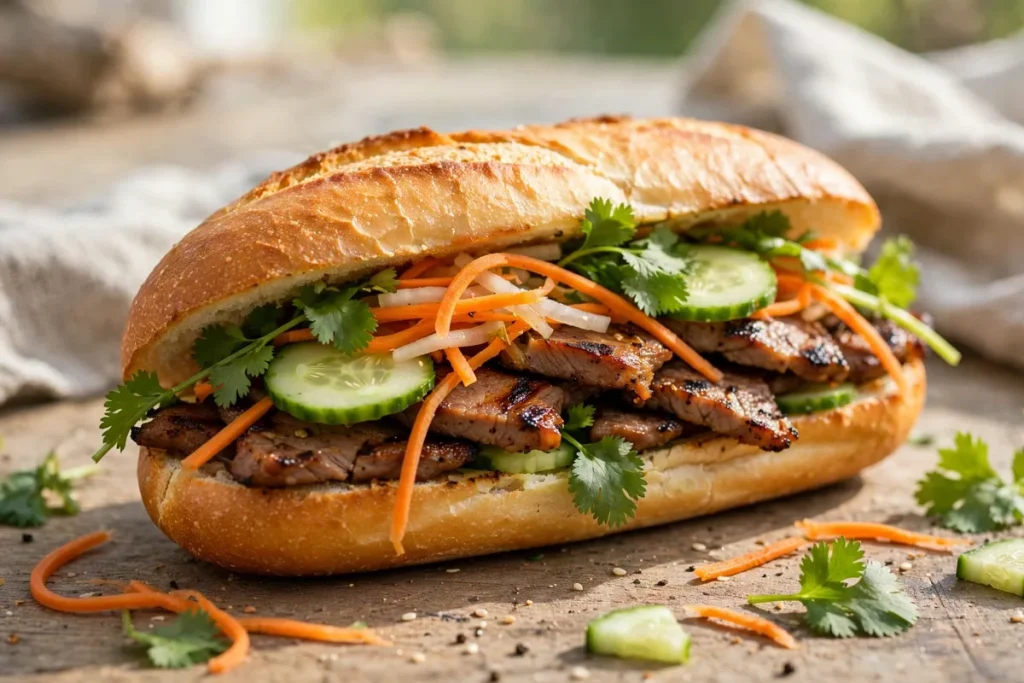

Banh mi calories come in at about 500 for a standard sandwich, and that number is honest in both directions: it is not a light lunch, and it is not a gut-buster either. All of the numbers in this guide are typical values, because a banh mi is a sandwich built in dozens of shops and kitchens, not a factory-made product with one label. Shops vary in roll size, in how thickly they spread the pate and mayo, and in how generous they are with the filling — so think of 500 as the middle of a range of roughly 400 to 650, not as a figure stamped on every banh mi ever made.
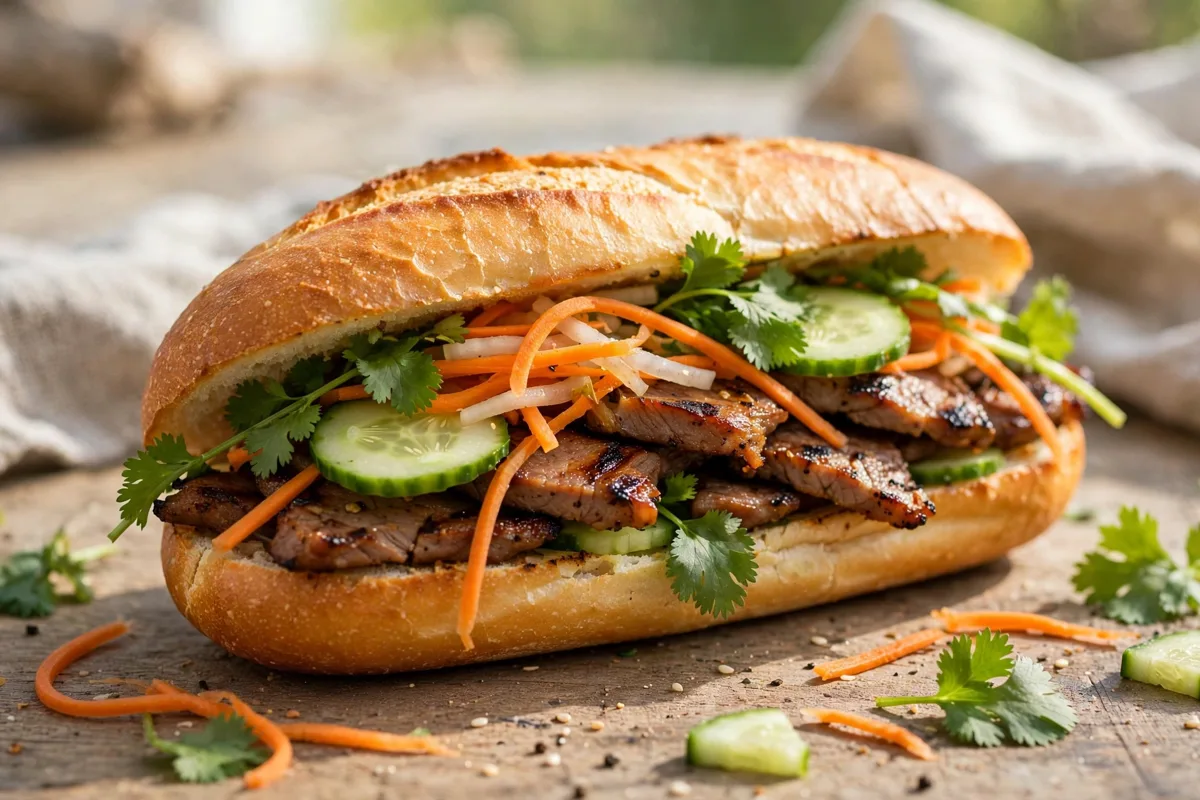
The short version is this: the bread and the spreads, not the vegetables, decide what a banh mi costs. The crisp baguette, the smear of pate and the mayonnaise do most of the work, while the pickled carrots, cucumber, cilantro and jalapeño that make the sandwich taste so bright add almost nothing. That is good news, because it means you can keep the sandwich you love and still move the number a long way with a few choices.
A banh mi is a Vietnamese sandwich built on a light, crisp baguette, usually with a spread of pate and mayonnaise, a protein filling, and a pile of pickled vegetables and fresh herbs. It is one of those sandwiches that eats bigger than its calorie count suggests — the pickles and herbs give it crunch and freshness, the protein makes it satisfying, and the roll, for all that it looks airy, is a serious piece of bread. This guide walks through the calories by filling, shows where the calories actually sit, and ends with a lighter build that keeps the character of the sandwich.
Banh Mi Calories by Filling
The filling matters, but less than most people expect. Swapping the protein changes the total by roughly a hundred calories, while the roll and spreads stay constant underneath. Here are the typical numbers for a standard shop-size sandwich, filling and all:
| Filling | Typical calories |
|---|---|
| Classic cold-cut (cha lua, pate and mayo) | About 550 |
| Grilled pork | About 530 |
| Grilled chicken | About 450 |
| Tofu | About 430 |
| Standard banh mi, average across fillings | About 500 |
The classic cold-cut version tops the list, because it is the one that most often gets the full pate-and-mayo treatment on top of the sliced cold cuts. Grilled pork runs close behind — pork shoulder and other grilled pork cuts carry a little more fat than chicken. Grilled chicken and tofu are the lighter end, both in the 430 to 450 range, which is a meaningful saving of about 100 calories against the classic without giving up the sandwich itself.
Where the Calories Sit: Bread, Pate and Mayo
If you take a banh mi apart, the numbers fall into a clear order. The roll is the single biggest item, and the two spreads together are nearly as big. Here is a typical breakdown for a standard sandwich:
| Part of the sandwich | Typical calories |
|---|---|
| The baguette roll | About 250-280 |
| Pate, one smear | About 60-80 |
| Mayonnaise, one tablespoon | About 90-100 |
| Filling (grilled pork, chicken, cold cuts or tofu) | About 90-180 |
| Pickled vegetables, cucumber, cilantro and jalapeño | About 15-25 total |
Start with the bread. A banh mi baguette looks light — it is airy, crisp and nowhere near as dense as a thick deli roll — but a full sandwich-size roll is still about 250 to 280 calories of refined white bread. That is more than half the sandwich before anything goes inside it. It is also the hardest part to trim without changing the sandwich, because the roll is what makes a banh mi a banh mi.
Then come the spreads, and this is where the quiet calories live. Pate is rich by nature — it is a liver-based spread, smooth and savory — and a typical smear adds about 60 to 80 calories. Mayonnaise is richer still: about 90 to 100 calories per tablespoon, and a shop spread can easily be a tablespoon or more across the roll. Together, pate and mayo can add about 150 to 180 calories to the sandwich. They are also, as you will see below, the easiest place to save.
The filling itself is the smallest lever in the sandwich. A serving of grilled chicken or tofu inside a banh mi runs roughly 90 to 120 calories, while grilled pork or cold cuts run higher, roughly 140 to 180. That range explains most of the difference between the fillings in the first table — but note that the bread plus spreads alone already account for about 400 calories, which is why even the lightest filling still lands around 430.
The Fresh Parts Are Nearly Free
Here is the part of the sandwich that deserves more credit. The pickled carrots and daikon, the cucumber slices, the cilantro, the jalapeño and the onion together add only about 15 to 25 calories to the whole sandwich. They are mostly water and fiber, and the pickling liquid adds flavor without adding fat or sugar in any meaningful amount.
That matters for two reasons. First, it means the crunch and brightness of a banh mi — the very things that make it different from a plain meat sandwich — come almost free. Second, it means loading up on the fresh parts is the one change that costs you nothing: ask for extra pickles, extra cucumber and extra herbs, and you get a bigger, fresher-tasting sandwich for maybe a handful of calories. It also helps with fullness — a sandwich stuffed with crunchy vegetables feels more substantial than the same sandwich with the vegetables picked out, even though the calorie difference is trivial.
The pickles do carry one honest caveat, and it is not about calories: pickled vegetables are salty, and so are the cold cuts and the pate. If sodium is something you watch, the fresh vegetables are still your friend, but the sandwich as a whole is not a low-sodium choice. The calories, though, are a different story — on that front, the fresh parts are the best deal in the sandwich.
A Lighter Banh Mi
Here is the good news: the lighter version of a banh mi still tastes like a banh mi, because the parts you keep — the crisp roll, the protein, the pickles and herbs — are the parts that define it. The parts you trim are the spreads, which add richness but not character. Four changes do the work:
- Pick chicken or tofu. Starting from a grilled chicken (about 450) or tofu (about 430) sandwich instead of the classic cold-cut (about 550) saves roughly 100 calories before you change anything else.
- Halve the mayo, or go light. A full tablespoon of mayonnaise is about 90 to 100 calories. Asking for light mayo or half the usual spread saves about 45 to 50. Skipping the mayo entirely saves the whole 90 to 100, though most people prefer to keep a thin layer for moisture.
- Skip the pate or keep it thin. Dropping the pate smear saves about 60 to 80. If you love the flavor, a thin smear rather than a thick one keeps most of it for roughly half the cost.
- Go big on the fresh parts, and consider a smaller roll. Extra pickles, cucumber and herbs cost almost nothing, and a smaller roll — or scooping out a little of the soft interior — trims the biggest single item. A smaller roll can save about 50 to 80 against a full-size one.
Put together, the math is friendly. A grilled chicken banh mi at about 450, with the mayo halved (about 45 saved) and the pate skipped (about 70 saved), lands around 335 — and with a slightly smaller roll it lands closer to 300. The brief for this guide puts the lighter build at about 380 to 420, and that range is the honest one for a full-size sandwich kept intact: chicken or tofu (about 430 to 450) with light mayo instead of full mayo and no pate, plus extra vegetables, lands right around 380 to 400. Either way, the point stands: you can keep the sandwich and cut roughly 100 to 150 calories from it without feeling shortchanged.
One more honest note: a lighter banh mi is still a white-bread sandwich, and it is still salty. The swaps move the calories, not the sodium, and they do not turn refined bread into whole grain. If you want the fiber to go with it, a side of fruit or a simple salad next to the sandwich does more than any filling swap. But for calories alone, the lighter build is a real improvement — about 380 to 420 instead of about 500 to 550.
The Bottom Line on Banh Mi
A standard banh mi runs about 500 calories, typically 400 to 650 depending on size and filling. The classic cold-cut version, about 550, is the heaviest; grilled chicken, about 450, and tofu, about 430, are the lightest of the usual fillings. The baguette alone is about 250 to 280, pate adds about 60 to 80 per smear, and mayonnaise adds about 90 to 100 per tablespoon — while the pickled vegetables and herbs that make the sandwich sing add only about 15 to 25 in total. Choose chicken or tofu, go light on the mayo, skip or thin the pate, and load up the pickles, and you have a banh mi of about 380 to 420 that still tastes like the real thing.
How many calories in a banh mi?
About 500 calories for a standard banh mi, typically in the range of 400 to 650 depending on the filling and the size of the roll.
How many calories in a chicken banh mi?
About 450 calories for a standard grilled chicken banh mi, with the usual pate, mayo and pickled vegetables.
What makes banh mi high in calories?
The baguette roll alone is about 250 to 280 calories, and the spreads add more: pate about 60 to 80 per smear and mayonnaise about 90 to 100 per tablespoon.
Is banh mi healthy?
It is mixed, honestly. You get lean protein and plenty of fresh vegetables, but the roll is refined white bread and the spreads, cold cuts and pickles are salty. The chicken or tofu versions with light mayo are the lighter end.
How can I make a banh mi lower in calories?
Pick chicken or tofu, ask for light mayo or half the usual amount, skip the pate or keep it thin, pile on the pickled vegetables and herbs, and consider a smaller roll. That lighter build lands around 380 to 420 calories.