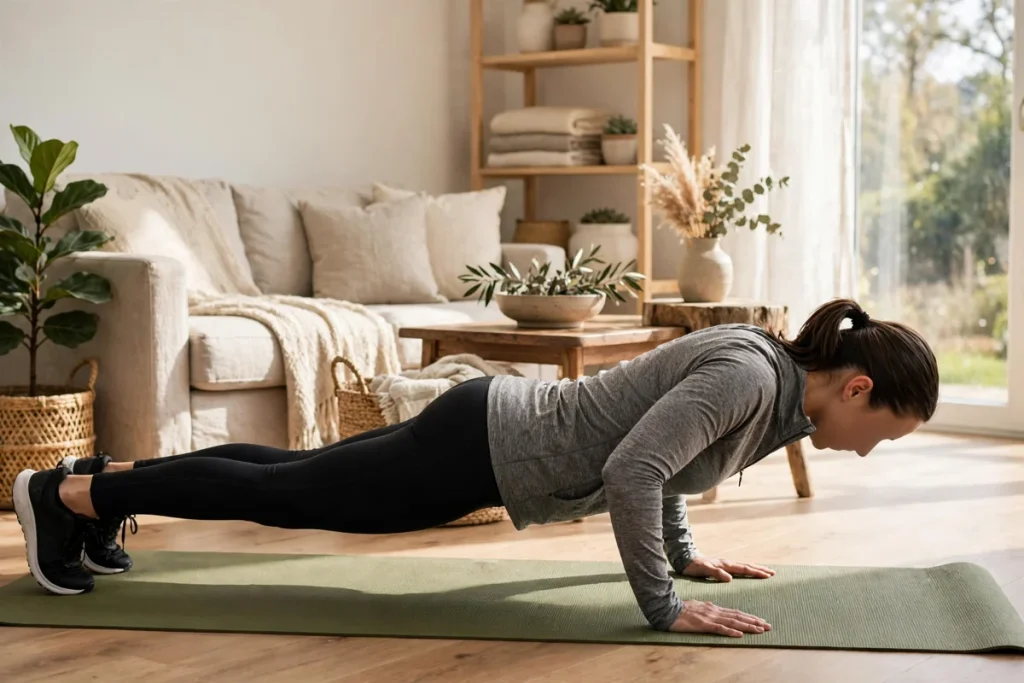

Short answer: push ups inwards vs outwards comes down to hand position, not to two different chest muscles. Your chest is one muscle, the pectoralis major, so no push-up can fully isolate an inner or outer chest. But where you put your hands changes the emphasis: a wide hand position with elbows flared loads the chest more, giving the outer sweep and stretch, while a narrow (diamond) position with elbows tucked shifts the work to the triceps and the squeeze in the middle of the chest. A standard shoulder-width push-up sits in between.
What inwards vs outwards actually means
People use inwards vs outwards in two different ways, and mixing them up causes most of the confusion:
- Hands in vs out (wide vs narrow): how far apart your hands are. This is the one that changes which muscles work hardest.
- Hands turned inwards vs outwards: which way your fingers point. Fingers pointing toward each other (turned in) or away from each other (turned out) mostly changes wrist and shoulder comfort, not muscle targeting. A slightly turned-out hand position feels natural for most people, while forcing your hands sharply inwards usually just hurts the wrists.
The 4 variations compared
Here is how the four common setups compare. The key trade-off: the wider your hands, the more chest stretch you get but the shorter the range of motion; the narrower your hands, the more your triceps take over.
| Variation | Hand position | Main muscles hit | Difficulty | Best for |
|---|---|---|---|---|
| Wide | Hands well outside shoulder width, elbows flared | Chest (outer sweep and stretch), front shoulders | Medium | Chest focus |
| Standard | Hands under the shoulders, elbows at about 45 degrees | Chest, triceps and front shoulders evenly | Easy to medium | Beginners and all-round strength |
| Narrow (diamond) | Hands close together under the chest, thumbs and index fingers touching, elbows tucked | Triceps first, then chest (middle squeeze) | Hard | Triceps and arm focus |
| Hands turned inwards | Hands close, fingers pointing toward each other | Same as narrow, but with more wrist strain | Hard on the wrists | Mostly avoid; use fists or handles instead |
Can you target the inner chest?
Honestly, only partly. There is no separate inner chest muscle to isolate: the pectoralis major is one muscle, and its fibres near the sternum, the inner part, work hardest at the top of the movement, when your hands come together and your chest squeezes. A narrow grip with a full lockout and a one-second squeeze at the top emphasises that feeling more than any other setup. If the inner-chest look is your goal, combine narrow push-ups with a full range of motion and a hard top squeeze rather than hunting for a magic hand angle.
How many calories do push-ups burn?
These figures are estimates, based on continuous moderate push-ups at roughly 0.4 calories per rep for a 155 lb person. Sets with long rests between them burn less per minute, because you are not working the whole time.
| Body weight | Calories per 100 push-ups | Calories per minute (25 reps/min) |
|---|---|---|
| 125 lb | About 32 | About 8 |
| 155 lb | About 40 | About 10 |
| 185 lb | About 47 | About 12 |
The per-minute maths is simple: 25 reps per minute times 0.4 calories per rep gives about 10 calories per minute at 155 lb. Push-ups are not a big calorie burner on their own; their value is the strength they build. We use the same per-rep maths in our jumping jacks calorie guide.
Which should you do?
- Beginners: start with standard shoulder-width push-ups, the balanced option that builds chest, triceps and shoulders together.
- Chest focus: mix wide and standard push-ups, so you get both the stretch of the wide position and the full range of the standard one.
- Triceps and arm focus: add narrow (diamond) push-ups, keeping the elbows tucked close to the body.
- Wrist pain: do push-ups on your fists or on handles, and avoid forced inward hand angles that twist the wrist.
For a full progression, our calisthenics workout lays out the push-up path from wall push-ups through incline and full push-ups to diamond and pseudo-planche versions, and our beginner workout plan builds push-ups into a simple 4-week full-body routine.
Form warnings
- Elbows flared to 90 degrees strains the shoulders. Keep your elbows at roughly 45 to 75 degrees from your body.
- Sagging hips take the work off your core and strain your lower back. Keep a straight line from head to heels, with glutes and core braced.
- Half reps do not count. Lower your chest to near the floor and lock out fully at the top of every rep.
Frequently Asked Questions
Do push-ups work the inner or outer chest?
Push-ups work the whole chest, which is one muscle (the pectoralis major). Wide hands emphasise the outer sweep and stretch, while narrow hands emphasise the triceps and the squeeze in the middle of the chest. No push-up isolates an inner or outer chest on its own.
Are wide push-ups better for chest?
For chest emphasis, yes. A wide hand position stretches the chest more at the bottom and loads it harder, although the range of motion is slightly shorter. Mix wide push-ups with standard push-ups for the best overall chest development.
What do diamond push-ups work?
Diamond push-ups are triceps-dominant. With your hands close together and elbows tucked, the backs of your arms do most of the work, with the chest helping most at the top squeeze.
How many calories do 100 push-ups burn?
About 40 calories for a 155 lb person at a moderate continuous pace (around 0.4 calories per rep), roughly 32 calories at 125 lb and 47 at 185 lb. These are estimates, and sets with long rests burn less per minute.
Do push-ups build the upper chest?
Push-ups mainly build the mid and lower chest. Decline push-ups, with your feet raised, shift some emphasis upward, but for serious upper-chest growth, incline pressing movements work better.