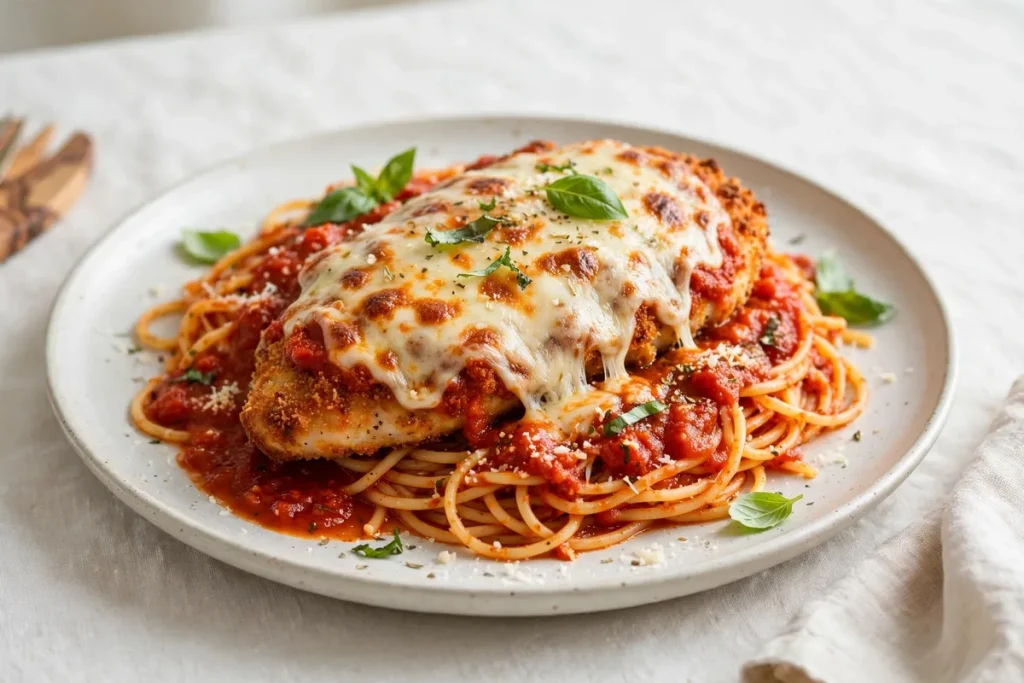

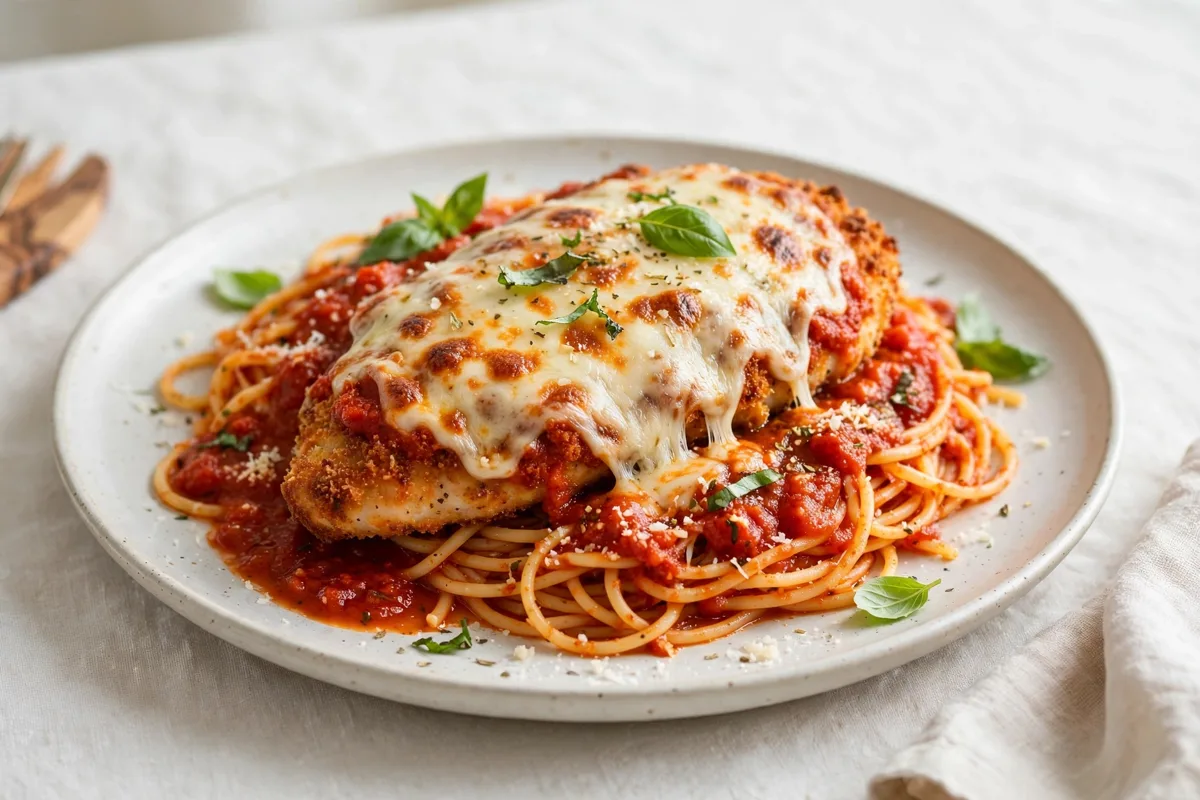
How many calories in chicken parmesan? About 550 for the cutlet with cheese and sauce — and about 1,000 as a full restaurant plate with pasta. That gap between the two numbers is the whole story of this dish, because most people picture the plate: a breaded cutlet buried under melted mozzarella and marinara, sitting on a generous bed of spaghetti. The cutlet alone is a serious but manageable meal; the plate is a feast.
Chicken parmesan — chicken parm, if you are on first-name terms with it — is one of the great Italian-American comfort dishes: a breaded chicken breast, fried until crisp, topped with tomato sauce and melted cheese, and usually served over pasta. It is also a dish where the calories stack up in layers, which is good news in a way — because when you can see the layers, you can change them one at a time.
One note before the numbers: chicken parmesan is a home and restaurant dish with no single official label, so every figure here is stated plainly as a typical value. Restaurant portions vary a lot, which is why the full-plate figure is given as a range — but the cutlet math below is consistent enough to count on.
Chicken Parmesan Calories: Cutlet vs Full Plate
Here are the typical values, starting with the parts that make up the cutlet, then the versions that change the total. The parts add up exactly: 380 + 100 + 70 = 550, which is the cutlet figure used throughout this guide.
| Item | Calories (typical) | Notes |
|---|---|---|
| Breaded fried chicken breast (part) | About 380 | The cutlet itself, fried |
| Mozzarella and parmesan (part) | About 100 | Roughly 1 oz melted mozzarella plus a sprinkle of parmesan |
| Marinara sauce, 1/2 cup (part) | About 70 | Tomato sauce over the cutlet |
| Cutlet only (no pasta) | About 550 | 380 + 100 + 70; protein about 45 g, fat about 28 g |
| Full restaurant plate (cutlet + about 1.5 cups spaghetti with marinara) | About 1,000 | Typical range 950–1,100 |
| Baked homemade version (cutlet) | About 420 | Estimate — baked not fried, part-skim mozzarella, lighter coating |
| Grilled chicken parmigiana style (no breading) | About 350 | Estimate — grilled chicken with sauce and cheese, no breading |
The cutlet’s macros tell a useful story on their own: about 45 grams of protein, which is a genuinely large serving of protein, and about 28 grams of fat. Sodium runs about 900–1,100 milligrams for the cutlet — the breading, the cheese and the sauce all contribute salt, so a full plate with salted pasta water and extra sauce can climb higher still.
The pasta is what turns a 550-calorie cutlet into a 1,000-calorie plate. About 1.5 cups of spaghetti with marinara adds roughly 450 calories on top of the cutlet — the pasta itself is most of it, with the extra sauce making up the rest. That is not a criticism of pasta; it is just the arithmetic of a double-starch dinner, and it is why the lighter version in this guide starts by changing the side, not by ruining the cutlet.
Where the Calories Sit
The biggest lever in chicken parmesan is the breading and the frying oil. A plain grilled chicken breast of the same size runs roughly 200–250 calories; bread it, fry it, and the same piece of chicken lands around 380. The coating itself is not enormous — breadcrumbs are mostly starch — but the coating soaks up oil in the fryer, and oil is about 120 calories per tablespoon. A thick, crunchy crust that has spent longer in the oil can easily carry an extra 100 calories over a thin, quick-fried one. If you only change one thing about the classic dish, this is the thing to change — which is exactly what the baked version below does.
Cheese is the second lever, at about 100 calories for the mozzarella and parmesan on a typical cutlet. That is roughly 1 ounce of melted mozzarella plus a sprinkle of parmesan, and it is money well spent in flavor terms — cheese is what makes chicken parm taste like chicken parm. But cheese portions are where restaurants get generous: a double layer of mozzarella, or a cutlet drowned under a ladle of extra cheese, can push the cheese share toward 200 calories without anyone noticing. At home, weighing out a single ounce keeps the dish honest.
The sauce, happily, is the light part. Half a cup of marinara over the cutlet is only about 70 calories, and it brings most of the dish’s brightness — the acidity that cuts through the fried coating and the rich cheese. Tomato sauce is mostly water and tomatoes, so even a generous spoonful or two barely moves the total. If a recipe or a restaurant version tastes heavy, it is almost never the sauce’s fault; it is the frying oil and the cheese doing the damage.
Put the three levers together and the ranking is clear: frying oil and breading first (the jump from about 200–250 for plain chicken to about 380 breaded and fried), cheese second (about 100, but easy to double), sauce a distant third (about 70 for half a cup). Knowing that order is what makes the lighter version work — you attack the biggest lever first and leave the sauce alone, because the sauce was never the problem.
A Lighter Baked Chicken Parm (About 420)
The baked version keeps everything people love about chicken parmesan — the crisp coating, the melted cheese, the tomato sauce — and changes the cooking method. Instead of frying, the breaded cutlet goes into a hot oven on a rack, brushed or sprayed lightly with oil so the coating still crisps. That single change is worth roughly 100 calories, because the coating absorbs far less oil than it does in a fryer. Use part-skim mozzarella instead of whole-milk, and keep the cheese to about an ounce, and you save a little more. Add a thinner coating — a light dusting of breadcrumbs rather than a thick double-dredged crust — and the cutlet lands around 420 calories. That figure is an estimate, since ovens and coatings vary, but it is a realistic one for a careful homemade version.
The swaps, in order of impact: bake instead of fry (the biggest saving); part-skim mozzarella measured at about an ounce (keeps the cheese share near 85 rather than letting it drift toward 200); a thinner, single-layer coating (less starch, less oil absorbed); and the same half cup of marinara, untouched, because the sauce was never the problem. None of these changes asks you to give up the dish — the baked cutlet still eats like chicken parmesan, just a lighter one.
The side dish is the other half of the lighter plate. A full 1.5-cup portion of spaghetti takes even the baked cutlet back toward 900 calories, so the smartest move is to change the side rather than shrink the cutlet: a smaller pasta portion, about half a cup, with a pile of vegetables — roasted broccoli, green beans or a simple salad — keeps the meal satisfying while holding the plate near 600–650 calories. Or skip the breading entirely and go grilled: the grilled parmigiana-style version, chicken with sauce and cheese but no breading at all, runs about 350 calories for the cutlet (estimate) and is the lightest way to keep the flavor profile intact.
None of this makes the classic version a villain. Chicken parmesan earns its place: about 45 grams of protein in the cutlet, real tomato sauce, and a flavor combination that has lasted generations for a reason. But knowing the numbers — 550 for the cutlet, about 1,000 for the full plate, about 420 for the baked version, about 350 grilled — lets you choose which version fits the day. Some days that is the full restaurant plate, enjoyed properly. Most days, the baked cutlet with vegetables on the side is the version that lets you have chicken parm again next week too.
Frequently Asked Questions
How many calories in chicken parmesan?
About 550 calories for the cutlet with cheese and sauce, and about 1,000 calories as a full restaurant plate with about 1.5 cups of spaghetti.
How many calories in chicken parm without pasta?
About 550 calories for the cutlet alone — breaded fried chicken breast (about 380) plus mozzarella and parmesan (about 100) plus half a cup of marinara (about 70).
Is chicken parmesan healthy?
It brings great protein (about 45 g per cutlet), but the breading, frying oil and cheese make it rich. The baked version at about 420 calories is the lighter regular choice.
How can I make chicken parm lighter?
Bake it instead of frying, use part-skim mozzarella measured at about an ounce, keep the coating thin, and serve vegetables on the side instead of a full pasta portion.
How much protein in chicken parmesan?
About 45 grams of protein for the cutlet — one of the most protein-rich comfort dishes you can order.