
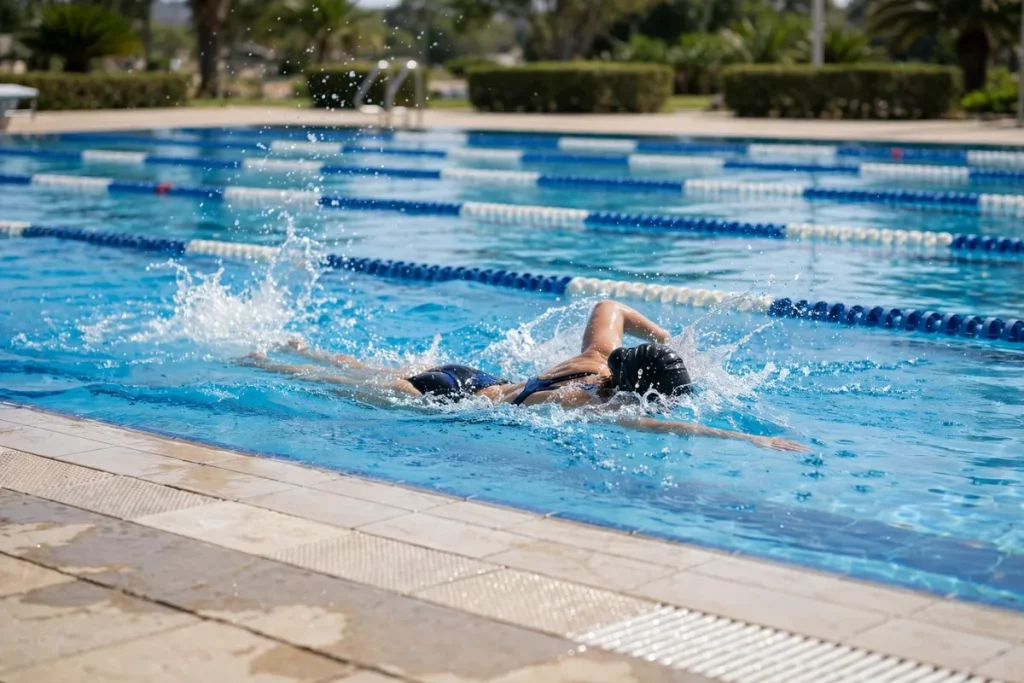
This swimming calorie calculator estimates your burn from your weight, your stroke and your time in the water — because a gentle breaststroke and a hard freestyle set are both “swimming”, but they are not the same workout.
Enter your weight, pick your stroke, add your minutes and press Calculate. The estimate uses the standard MET value for each stroke — the same method exercise labs use — so the number reflects the swim you actually did, not a generic guess.
Calories per Hour by Stroke
Here is what one hour of each stroke costs a 154 lb (70 kg) swimmer. Lighter swimmers burn a little less and heavier swimmers a little more, but the ranking between strokes stays the same — which is why stroke choice is the biggest lever you control.
| Stroke | kcal per hour |
|---|---|
| Treading water | 293 |
| Leisurely swimming | 440 |
| Backstroke | 587 |
| Freestyle — moderate laps | 609 |
| Freestyle — vigorous/fast | 719 |
| Breaststroke | 755 |
| Butterfly | 807 |
Breaststroke surprises people: the whip kick and the constant glide-and-resist cycle make a hard breaststroke set cost more than cruising freestyle. Butterfly tops the table — but almost nobody sustains true butterfly for an hour, while a fit swimmer can hold strong breaststroke or fast freestyle that long. And notice the spread inside the realistic strokes: moving from leisurely laps to vigorous freestyle raises the hourly burn by more than half, without adding a single minute to your session.
One caution about pool watches: many trackers default to freestyle and over-credit breaststroke and drills. If your watch and this table disagree, plan with the table and use the watch for trends.
Why Two Swimmers Burn Differently
Two swimmers of the same weight can finish the same 45 minutes with noticeably different burns, and technique is the multiplier. An efficient swimmer glides — long strokes, a quiet body line, very little wasted splash — so each length costs less energy. A beginner fights the water: head high, legs sinking, arms thrashing. That struggle is expensive, so a less skilled swimmer often burns more per minute at the same speed, while actually covering less distance.
Two smaller factors matter too. Cool water adds a modest thermogenesis cost, because your body spends extra energy holding its temperature — one reason pool sessions feel so draining. And rest counts: this calculator prices moving time. If your 45-minute session includes 12 minutes of hanging on the wall chatting, enter 33 minutes. Honest minutes in, honest calories out.
Lap Math
Prefer laps to minutes? Work an example. In a standard 25 m pool, a 70 kg swimmer holding a moderate freestyle pace — about 609 kcal per hour — covers roughly 2,500 to 3,000 m in that hour. That is about 100 to 120 lengths of the pool. Turn it around and each 1,000 m costs roughly 200 to 245 kcal, so a tidy 40-length kilometer lands near the cost of a small snack, and a 2 km session near a full meal’s worth of burn.
For the bigger picture — joints, heart health, technique starters and how swimming stacks up against other cardio — read our deeper guide: is swimming good exercise?
Frequently Asked Questions
How many calories does swimming burn in 30 minutes?
About 220 to 380 for most adults, depending on stroke. At 154 lb that is roughly 220 kcal for leisurely laps, about 305 for moderate freestyle and up to about 378 for breaststroke — and your weight moves the number from there.
Which stroke burns the most calories?
Butterfly, per minute — about 807 kcal per hour at 154 lb. The practical winner is breaststroke at about 755 per hour: it is the hardest stroke most swimmers can actually sustain, while butterfly defeats almost everyone within a few lengths.
Is swimming better than running for calories?
Per hour, vigorous swimming sits in running’s league — fast freestyle and breaststroke rival a solid run — and it does it with almost no joint impact. Running usually wins per minute at top speeds, but swimming wins for sore knees, heavier bodies and anyone who will simply do it more often.
Why does the pool make me so hungry?
Cool water plus big-muscle work is a powerful appetite trigger: your body burns fuel for the swim, then more to warm back up afterwards. Plan the post-swim meal before you get in — protein and real food ready at home beats meeting the snack bar unprepared.
How accurate is this calculator?
It is a MET-based estimate — the standard research method, planning-grade rather than lab-grade. Technique, water temperature and how much of your session is real moving time all move the true number, so use it to plan and compare, not as a verdict.
The bottom line: swimming’s burn is yours to dial. Pick a harder stroke, tighten your technique, and protect your moving time from wall-rest creep, and the same 45 minutes in the same pool can cost half again as much — no extra time in the water, and no pounding on your joints.