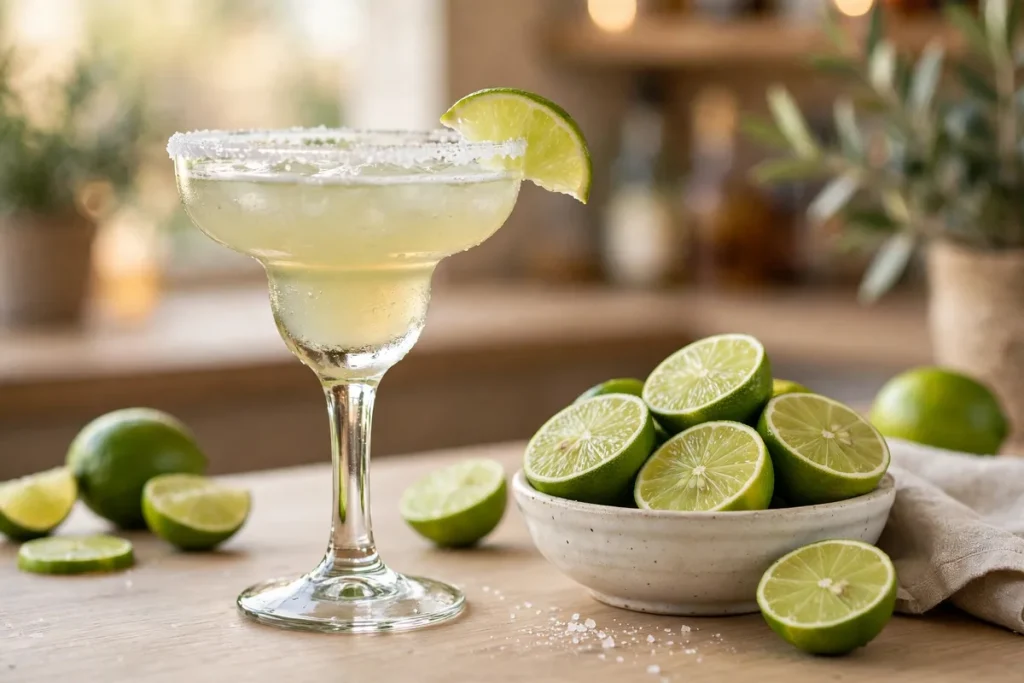

Let’s get straight to it: how many calories in a margarita? A classic margarita on the rocks — about 4 oz — has roughly 170 to 220 calories, and a from-scratch one built on fresh lime lands near 180. We can anchor that to official data, too: the USDA’s FoodData Central lists a standard “margarita” at 122 calories per 100 grams, which works out to about 145 calories for a 4 oz pour — so the typical bar-made classic sits right around (or just above) that official figure.
But that classic is the best-case scenario. A homemade frozen margarita usually runs about 250 to 350 calories, large fruity restaurant versions can sail right past 500, and a skinny margarita made with fresh citrus and soda water lands near 100 to 130. In this guide you’ll get the full breakdown by style and size, see exactly where the calories hide, and learn how to build a proper skinny margarita for about 120 calories — salt rim included.
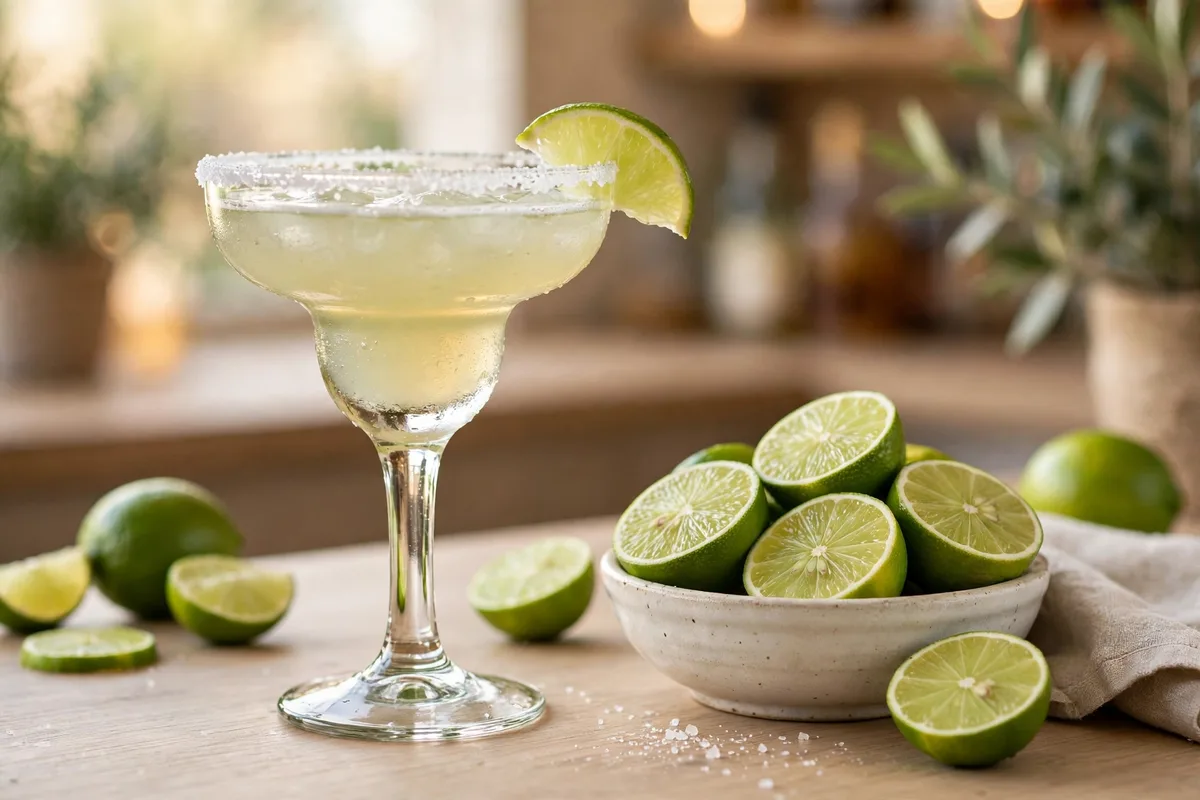
Where a Margarita’s Calories Come From
A margarita is only four or five ingredients, so it’s tempting to file it under “light drinks.” The truth is that two of those ingredients do nearly all the damage — and they’re the two most people never think to question.
| Ingredient | Typical amount | Calories |
|---|---|---|
| Tequila (80 proof) | 1.5 oz | about 97 kcal |
| Orange liqueur / triple sec | 1 oz | about 100–110 kcal |
| Fresh lime juice | 1 oz | about 8 kcal |
| Agave syrup or simple syrup | 0.5 oz | about 30–60 kcal |
| Sweet-and-sour mix | 2 oz | about 90–120 kcal |
Add those up and a typical shaker holds roughly 235 to 275 calories before dilution and ice melt bring a finished 4 oz pour into that 170–220 range. The lesson is simple: the liqueur and the sweetener are the swing factors, not the lime. Fresh lime juice costs you about 8 calories an ounce, so squeeze freely — while the orange liqueur carries as many calories as the tequila itself. Swap the fresh lime for bottled sweet-and-sour mix and you’ve nearly doubled the drink’s calories without changing its name.
Calories by Style
Recipes and pour sizes vary wildly, so here’s how the main styles compare at the sizes you’re most likely to actually be served:
| Style | Typical size | Calories |
|---|---|---|
| Classic on the rocks | about 4 oz | about 170–220 |
| Frozen classic (blended with ice) | about 8 oz | about 250–350 |
| Skinny margarita | about 4 oz | about 100–130 |
| Fruity frozen restaurant margarita (strawberry/mango) | 12–16 oz | about 450–600 |
| Ready-to-drink canned/bottled margarita | 12 oz | about 250–350 (check the label — they vary a lot) |
See the pattern? It’s not the tequila driving the differences — a standard 1.5 oz shot is always about 97 calories. The spread comes from the sweeteners and the sheer volume in the glass. That ready-to-drink can deserves a special warning: formulations vary enormously between brands, so always check the label before you count it.
Why Frozen and Restaurant Margaritas Run So High
Blending a margarita doesn’t add calories by itself — ice is free. What makes frozen and restaurant margaritas so much heavier is everything around the ice:
- Bigger pours: a frozen margarita served in a 12 to 16 oz goblet can hold two to three times the liquid of a classic rocks pour.
- Sweet-and-sour mix instead of fresh lime: the bottled mix is essentially sugared lime cordial, adding 90 to 120 calories per 2 oz — while fresh lime juice adds about 8 per ounce.
- Extra syrup or agave: many bars add a half ounce or more of agave syrup “to balance the tartness,” and each half ounce adds another 30 to 60 calories.
- Flavoured purées: strawberry, mango and other fruit purées or frozen drink bases pile their own sugar on top of everything else. A large frozen restaurant margarita can carry more sugar than a dessert.
This is why two drinks with the same name can be hundreds of calories apart. A 4 oz classic built on fresh lime is a fundamentally different drink from a 16 oz frozen strawberry margarita built on sweet-and-sour mix — even though the menu calls both of them a margarita.
How to Make a Skinny Margarita (About 120 Calories)
The skinny margarita isn’t a sad diet compromise — if anything, it’s closer to the drink’s roots. Drop the orange liqueur and the syrup, lean on fresh citrus, and top with soda water for volume. Here’s the build:
- 1.5 oz tequila (about 97 kcal)
- 1 oz fresh orange juice (about 14 kcal)
- 0.5 oz fresh lime juice (about 4–8 kcal)
- Splash of soda water (0 kcal)
- Plenty of ice
- Salt for the rim (negligible calories)
Total: about 115–120 kcal.
- Salt the rim of a rocks glass: run a lime wedge around the edge and dip it in coarse salt, then fill the glass with ice.
- Add the tequila, fresh orange juice and fresh lime juice to a shaker filled with ice.
- Shake hard for about 10 seconds — you want it properly cold.
- Strain over the fresh ice in your salted glass.
- Top with a splash of soda water, give it one gentle stir, and garnish with a lime wheel.
The fresh orange juice does the job the liqueur used to do — a whisper of orange flavour — for about 14 calories instead of 100-plus. And once the salt, lime and ice are doing their thing, you genuinely won’t miss the syrup.
Margarita vs Beer and Wine
So where does a margarita sit in the broader drinks lineup? Here’s the honest head-to-head at standard serving sizes:
- Regular lager (12 oz): about 150 kcal
- Light beer (12 oz): about 103 kcal
- Red or white wine (5 oz): about 120–125 kcal
A classic margarita at 170 to 220 calories sits a bit above wine and beer — and that’s almost entirely because of the orange liqueur. Choose the skinny version at about 120 and you’re sitting between the two beers, roughly on par with a glass of wine. A frozen restaurant margarita, on the other hand, equals three to four light beers in a single glass. Framed that way, the choice at the bar gets pretty easy.
An Honest Note on Alcohol and Weight Loss
Can a margarita fit into a weight-loss plan? It can — but it helps to understand what alcohol does beyond the raw calorie count. Alcohol itself carries about 7 calories per gram, nearly as much as fat, and your body treats it as a priority fuel: while it’s busy processing the alcohol, fat burning essentially pauses. Those are real calories you can’t out-think; they count exactly like any others.
Then there’s the behavioural side. Drinks loosen food discipline — this is the late-night snack effect, and it’s real. The margarita didn’t just cost you 200 calories; it may have quietly authorised the chips, the queso and the second basket of whatever showed up at the table.
None of this means margaritas are off the menu forever. It means they work best as planned occasions, not spontaneous ones: pick the classic or skinny version, keep it to one, and count it in the day like any other treat. If you don’t know your own daily target yet, start with our Maintenance Calories Calculator and build the drink into the plan — one 200-calorie margarita a week does not undo a sensible deficit.
This is general information, not medical advice. And whatever you’re drinking, drink responsibly.
Burn It Off
For a concrete sense of what 200 calories costs in movement: a 200 kcal margarita takes a 70 kg person roughly 45 to 50 minutes of walking to burn off. Walking is one of the most underrated calorie burners out there — see our full breakdown of calories burned walking for the numbers by pace and body weight.
How to Order a Lighter Margarita at the Bar
You don’t have to interrogate your bartender to save serious calories — a few small tweaks to your order do most of the work. Start by asking for your margarita on the rocks rather than frozen; you’ll get a smaller pour in a smaller glass, which alone can halve the calories. Then ask for fresh lime juice instead of the sweet-and-sour mix — most bars keep limes on hand, and this one swap cuts roughly 80 to 100 calories of pure sugar.
Next, ask them to go easy on the agave or simple syrup, or to skip it entirely — the orange liqueur already brings plenty of sweetness. If you’re feeling bold, ask for “half the triple sec”; you’ll barely notice the difference once the lime and salt are doing their jobs, and you’ll save another 50 or so calories. Finally, steer clear of the flavoured purées and giant goblets. A classic margarita in a rocks glass with fresh lime is not only the lighter choice — most cocktail folks will tell you it’s the better-tasting one, too.
The Bottom Line
So, how many calories in a margarita? A classic on the rocks lands around 170 to 220, a homemade frozen one around 250 to 350, and those enormous fruity restaurant versions can sail past 500 without breaking a sweat. The skinny version, built on fresh citrus and soda water, keeps things near 120. The pattern is always the same: it’s the orange liqueur and the sweetener — not the tequila, and definitely not the lime — that decide the final number. Keep that in mind, count the drink like anything else, and there’s no reason a margarita can’t have a standing appointment in your week.
How many calories are in a frozen margarita?
Typically about 250 to 350 calories for a homemade frozen margarita of about 8 oz. Restaurant versions are poured larger and sweeter, and commonly reach 450 to 600 calories.
How many calories are in a skinny margarita?
About 100 to 130 calories. A skinny margarita swaps the orange liqueur and syrup for fresh citrus and soda water, keeping the tequila — which alone is about 97 calories a shot — as almost the only calorie source.
Is a margarita more calories than beer?
Usually, yes. A classic margarita (170 to 220 calories) beats a regular lager (about 150) and a light beer (about 103), mostly because of the sweet orange liqueur. A skinny margarita, at about 120, sits between the two beers.
Why are restaurant margaritas so high in calories?
Size and sweetness: larger pours, sweet-and-sour mix instead of fresh lime, extra syrup or agave, and sweet fruit purées. A large frozen restaurant margarita can carry more sugar than a dessert.
Can I drink margaritas and still lose weight?
Yes, if they are planned and counted. Pick the classic or skinny version, keep it to one, and fit it into your daily calorie target like any other treat — one 200-calorie margarita a week does not undo a sensible deficit.