How many calories in chicken noodle soup? About 130 per cup if it is homemade, and about 110 per cup from a can. It is one of the lightest comfort foods out there, and the reason is simple: most of what is in the bowl is broth.
That lightness is what makes chicken noodle soup such a handy meal when you want something warm and filling without a heavy calorie count. A restaurant bowl, about 2 cups, comes to roughly 260 calories, and even a whole standard can lands around 220. You would have to eat a lot of soup to match a single cheeseburger.
One note before the numbers: chicken noodle soup is a home and canned food, not a single labeled product, so the figures below are typical values. Cans vary by brand, and homemade pots vary by how generous you are with the noodles and the chicken. The table gives the typical range so you can see where your bowl probably sits.
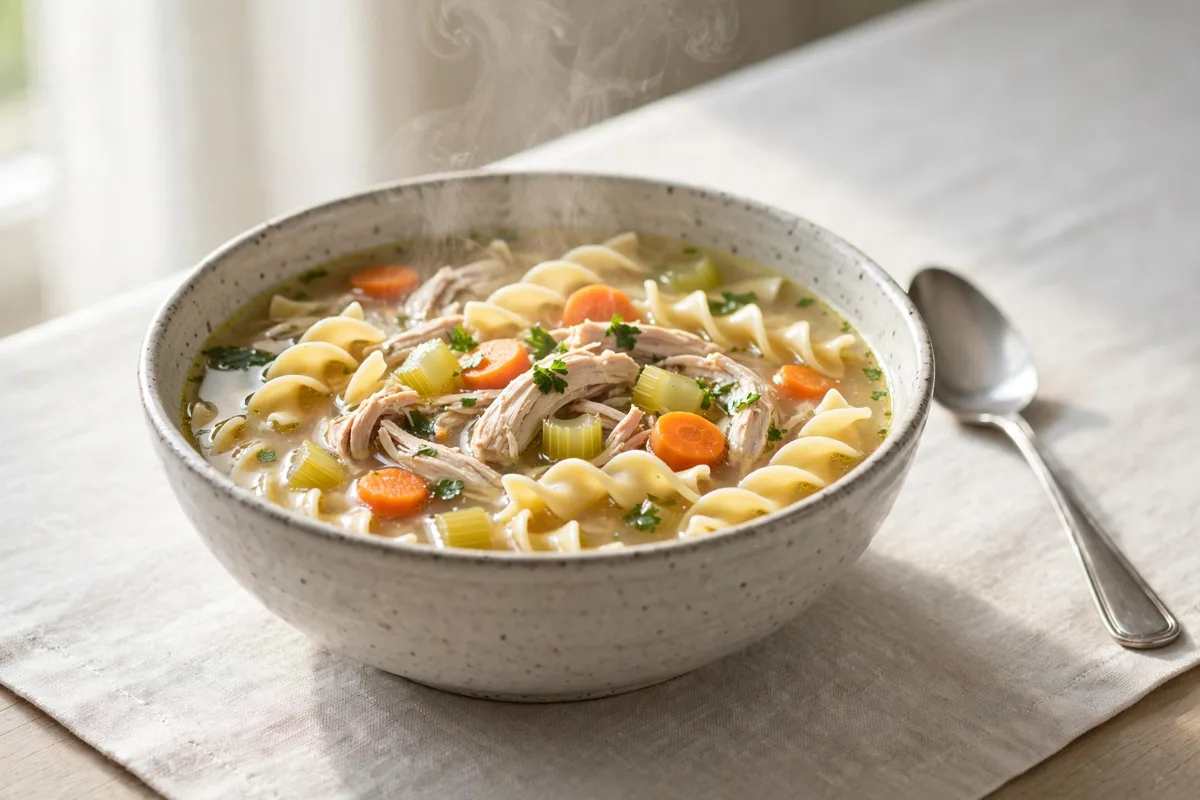
Chicken Noodle Soup Calories by Serving
Here are the typical values, from the lightest measure to the whole can:
| Serving | Calories (typical) | Notes |
|---|---|---|
| Per 100 g | About 50–55 | Mostly broth — a genuinely light food |
| Canned ready-to-eat, 1 cup | About 110 | Protein about 7 g; sodium about 800–900 mg |
| Homemade, 1 cup | About 130 | Typical range 120–150; protein about 8 g |
| Homemade, extra-noodle cup | About 170 | Estimate — more noodles, more calories |
| Restaurant bowl (about 2 cups) | About 260 | Two cups of homemade-style soup |
| Whole standard can (about 2 cups / 19 oz style) | About 220 | Two canned cups |
The homemade cup’s macros are kind to you: about 8 grams of protein, about 16 grams of carbs, and only about 3–4 grams of fat. Sodium is the one number to watch at home too, at about 600–700 mg per cup, but at least the home cook controls the salt shaker, which is more than you can say for a can.
Why the Numbers Differ
The biggest lever in chicken noodle soup is the noodles. Noodles are the densest part of the bowl, and a cook who is generous with them can push a cup from about 130 calories toward 170 without changing anything else. That is exactly what the extra-noodle cup in the table shows: same broth, same chicken, just more pasta, and the count climbs by about 40 calories. If you ladle your soup mostly broth with a modest tangle of noodles, you will sit at the low end of the range.
The second lever is how rich the broth is. A clear, well-skimmed broth made with chicken breast keeps the fat at about 3–4 grams per cup. A broth made from a fattier cut, or one that keeps all the fat that rises to the top, runs richer and heavier. It still will not turn soup into a heavy meal — broth is mostly water, after all — but it explains why one homemade pot can read 120 per cup and another 150.
Then there is the canned trade-off, and it is worth saying plainly: canned soup is actually a little lighter in calories, at about 110 per cup, but it pays for that convenience with salt. A canned cup typically carries about 800–900 mg of sodium, against about 600–700 mg for a homemade cup, and the gap comes from salt’s job in a can — it preserves the soup and flavors it. So the can wins on calories and loses on sodium, which is the real catch in this food.
Put together, the ranking is clear: noodle amount moves the calories most, broth richness second, and the canned-versus-homemade choice is really a sodium decision rather than a calorie decision. None of these versions is a heavy food, which is why chicken noodle soup keeps its reputation as the comfort food you can eat when you are watching your intake.
Making It More Filling Without Many More Calories
Chicken noodle soup’s one weakness is that a plain cup can leave you hungry again an hour later. The fix is not a second bowl — it is loading the bowl you already have with the parts that fill you up for the fewest calories. Extra vegetables are the best first move: another handful of carrots, celery, onion or spinach adds bulk and fiber for only about 20–30 calories, and it turns a thin soup into something you actually chew.
More chicken is the second move, and the protein per calorie here is already good. A typical homemade cup carries about 8 grams of protein; doubling the chicken in your portion adds roughly 50 calories and about 8 more grams of protein, which is a trade most people will happily make. Protein is what keeps you full, so a chicken-heavy cup stays with you far longer than a noodle-heavy one at the same calorie count.
Whole-wheat noodles are the third swap. They do not change the calorie count much — a cup made with whole-wheat noodles lands in the same 130-ish range — but the extra fiber slows you down and keeps you satisfied longer. If you like a heartier bowl, whole-wheat noodles give you that feeling without pushing the cup toward the 170-calorie extra-noodle territory.
There is also a small eating trick worth knowing: eat the broth and vegetables first and save the noodles for last. Broth fills your stomach with warm liquid, the vegetables give you something to chew, and by the time you reach the noodles you are already partly satisfied — so a single cup feels like a meal instead of a starter.
Put it together and a loaded bowl — extra vegetables, a double portion of chicken, whole-wheat noodles — still lands around 180–200 calories per cup, which is a genuinely light meal by any standard. And if you are reaching for a can, look for a low-sodium version: you keep the same roughly 110 calories per cup while cutting the sodium catch that makes canned soup the salty choice.
Frequently Asked Questions
How many calories in a cup of chicken noodle soup?
About 130 calories for a homemade cup (typical range 120–150), and about 110 calories for a canned ready-to-eat cup.
How many calories in a whole can of chicken noodle soup?
About 220 calories for a whole standard can, which holds about 2 cups (19 oz style).
Is chicken noodle soup good for weight loss?
It is one of the lighter comfort foods: filling broth, decent protein at about 7–8 grams per cup, and only about 130 calories per homemade cup. Just watch the sodium in canned versions, which runs about 800–900 mg per cup.
How much protein in chicken noodle soup?
About 8 grams per homemade cup, and about 7 grams per canned cup.
Why is canned soup so high in sodium?
Salt preserves and flavors canned soup, which is why a canned cup runs about 800–900 mg of sodium. Low-sodium versions exist if you want the convenience without the salt.
The Bottom Line on Chicken Noodle Soup
Chicken noodle soup earns its reputation honestly. At about 130 calories per homemade cup and about 110 per canned cup, it is one of the few comfort foods that is genuinely light, and the reason never changes: the bowl is mostly broth. A restaurant bowl at about 260 calories is a full, satisfying meal, and even a whole can at about 220 calories stays well under what most single-dish lunches cost you.
The numbers to actually watch are not the calories at all. Watch the noodles, because they are what push a cup from 130 toward 170, and watch the sodium, because a canned cup at 800–900 mg carries a real share of a day’s salt. Homemade soup wins on sodium at 600–700 mg per cup, and it wins again because you choose how much chicken and how many vegetables go in.
So ladle generously, go easy on the noodle scoop, load the bowl with vegetables and chicken, and reach for a low-sodium can when time is short. That is chicken noodle soup at its best: warm, filling, high in protein for its size, and light enough that you can enjoy a second cup without a second thought.