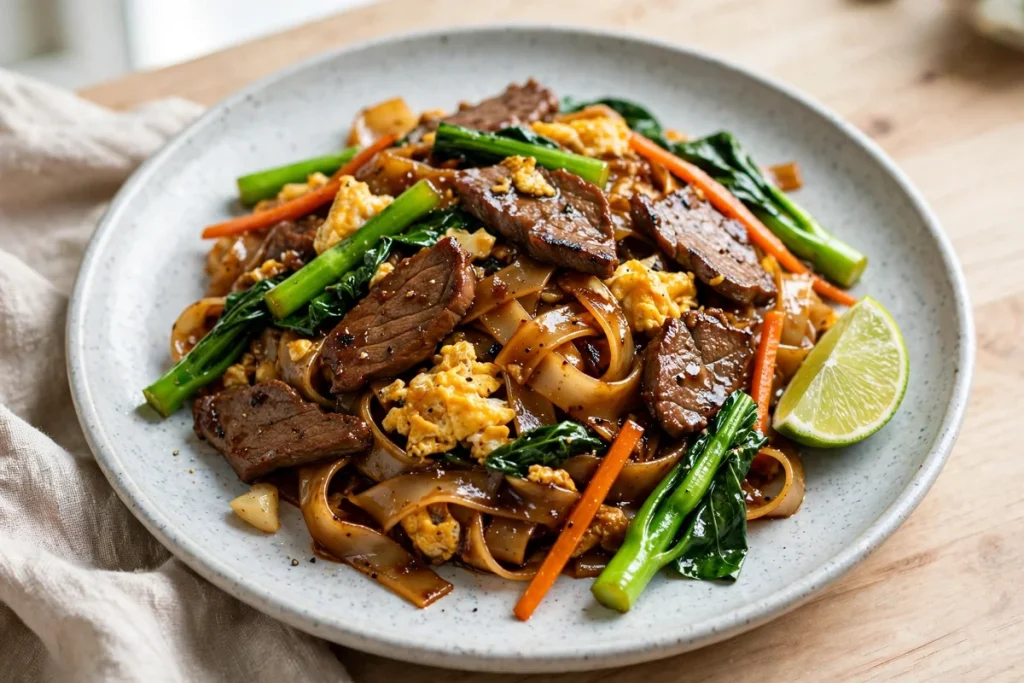

Pad see ew calories are the first thing most people ask about this Thai favorite, and the answer is reassuringly simple: a typical restaurant plate of chicken Pad See Ew has about 600–750 calories, while a lighter homemade version comes in at roughly 450–550. The swing between those two numbers comes almost entirely from the cooking oil and the sweet sauce, as the breakdown below shows. Searched for ‘pad see you calories’? Same dish — here is the full breakdown.
Pad See Ew (sometimes written Pad See-Ew) is a Thai stir-fry of wide, flat rice noodles tossed with egg, Chinese broccoli (gai lan), a dark sweet soy sauce and a protein — usually chicken, beef, shrimp or tofu. It is less tangy and peanut-heavy than Pad Thai, and its flavor comes from the caramelized sauce coating the noodles rather than a pile of toppings.
What is in a plate of Pad See Ew?
A restaurant plate is built from just a handful of parts, and each one pulls the total in a different direction. The noodles are the biggest single source of calories, the oil is the sneakiest, and the sauce is where most of the sugar hides. Here is how a typical chicken plate adds up. All figures are estimates for a standard restaurant serving, based on standard USDA-style values for a generic dish.
| Component (typical restaurant plate) | Amount | Calories |
|---|---|---|
| Flat rice noodles, cooked | About 250 g | 250 |
| Chicken breast, cooked | 120 g | 200 |
| Sweet dark soy sauce | 2 tablespoons (about 12 g sugar) | 70 |
| Egg, scrambled in | 1 large | 70 |
| Cooking oil | About 1 tablespoon | 120 |
| Chinese broccoli (gai lan) | 1 cup | 30 |
| Total — chicken Pad See Ew plate | 740 |
Add those up and you get 740 calories — right at the top of the 600–750 range, which is exactly where a generous restaurant portion lands. Smaller takeout boxes, or restaurants that go lighter on the oil, will come in closer to 600. The same plate made at home, where you control the oil and the sauce, is a different story, as the lighter version further down shows.
Pad See Ew calories by protein
Changing the protein changes the total more than most people expect, because the rest of the plate stays the same. Keeping the noodle, sauce, egg, oil and gai lan base fixed at 540 calories, here is how the four common versions compare:
| Version (same 540-calorie base) | Protein calories | Plate total | Protein |
|---|---|---|---|
| Chicken breast, 120 g | 200 | 740 | About 50 g |
| Beef strips, 120 g | 250 | 790 | About 45 g |
| Shrimp, 120 g | 120 | 660 | About 37 g |
| Firm tofu, 150 g | 180 | 720 | About 33 g |
Shrimp is the lightest choice and tofu sits in the middle, while beef is the heaviest — mostly because beef brings more fat with it. If protein per calorie is what you care about, chicken wins: about 50 g of protein for 740 calories. For a deeper look at how protein calories work, see our guide to calories in protein.
Pad See Ew nutrition: the full picture
Calories only tell part of the story. For a typical restaurant plate of chicken Pad See Ew, expect roughly these ranges. They are estimates, because every restaurant seasons and oils its wok differently:
- Protein: 45–55 g
- Carbohydrates: 70–80 g, mostly from the noodles
- Fat: 20–25 g, mostly from the cooking oil
- Sugar: 12–16 g, almost all from the sweet sauce
- Sodium: 1,200–1,800 mg, from the soy sauces
- Fibre: 3–5 g, mostly from the gai lan
That sodium figure is the one worth watching: a single plate can carry well over half of a day’s recommended sodium, especially if extra soy sauce is added at the table. The fibre is modest — the dish is built on refined rice noodles — so pairing it with extra vegetables is the easiest nutritional upgrade.
Why is Pad See Ew so high in calories?
Three things do most of the damage, and none of them is the noodles alone. First, the oil: a tablespoon of cooking oil adds 120 calories before a single noodle hits the wok, and restaurant woks are rarely shy with it. Second, the sauce: two tablespoons of sweet dark soy sauce add about 70 calories and 12 g of sugar, and the sauce is what makes the dish taste like itself, so restaurants do not skimp on it. Third, the portion: a restaurant plate is a large serving, often 500–600 g of food, so even modest per-bite numbers add up fast.
Is Pad See Ew healthier than Pad Thai?
It is close, and the answer depends on the restaurant. A typical Pad Thai lands in a similar range, often 600–900 calories, but it usually carries more sugar from its tamarind sauce and extra calories from crushed peanuts. Pad See Ew skips the peanuts and keeps its sweetness to the dark soy sauce, so it often comes out a touch lighter and lower in sugar — but a heavy-handed wok cook can erase that advantage in either dish. Our chicken fried rice calories breakdown shows the same pattern: with noodle and rice dishes, the oil and sauce decide the total more than the base does.
How to make Pad See Ew lower in calories
You do not need to give up the dish. Five small changes take a restaurant-style 740-calorie plate down toward 500:
- Use half the sauce, or ask for it on the side: saves about 35 calories and roughly 6 g of sugar.
- Cook with 1 teaspoon of oil instead of 1 tablespoon: saves about 80 calories.
- Halve the noodles and double the gai lan: saves about 95 calories net, and adds fibre.
- Pick chicken breast over fattier cuts: saves about 50 calories versus chicken thigh.
- Serve a smaller noodle portion: cutting the noodles from 250 g to 150 g cooked saves about 100 calories.
Put together, a lighter homemade plate looks like this: 150 g of noodles (150 calories), 90 g of chicken breast (150 calories), half the sauce (35 calories), one egg (70 calories), a teaspoon of oil (40 calories), a cup of gai lan (30 calories) and an extra handful of vegetables (25 calories) — about 500 calories in total, with roughly 40 g of protein. That is squarely in the 450–550 homemade range, and it still tastes like Pad See Ew.
Ordering Pad See Ew at a restaurant
If you are eating out, ask for light oil and the sauce on the side — those two requests alone can cut 100 calories or more. Choose chicken or shrimp over beef, ask for extra gai lan or mixed vegetables, and skip the extra soy sauce at the table to keep the sodium down. If the portion is huge, eating half and taking the rest home turns one 740-calorie plate into two sensible meals.
Fitting Pad See Ew into your day
A 740-calorie plate is a full meal, not a snack — but it fits comfortably into most daily totals, especially if the rest of the day is lighter. If you are tracking intake, checking how many calories you should eat to lose weight or your maintenance calorie calculator total first makes it easier to decide whether the restaurant or the lighter homemade version is the right call that day.
The bottom line
Pad see ew calories come down to a simple trade: the restaurant plate at 600–750 calories is a satisfying, protein-rich meal, and the homemade version at 450–550 calories keeps everything you like about it with less oil and less sugar. Order the chicken or shrimp version, go easy on the sauce, and load up the gai lan — and this Thai classic earns its place in a regular rotation.
All figures in this article are estimates based on standard USDA-style values for a generic restaurant dish; actual plates vary with portion size, oil and sauce.
How many calories are in Pad See Ew?
A typical restaurant plate of chicken Pad See Ew has about 600 to 750 calories. Our component breakdown totals 740 calories for a generous plate, while a lighter homemade version comes in at roughly 450 to 550 calories.
Is Pad See Ew healthier than Pad Thai?
Often, slightly. A typical Pad Thai runs 600 to 900 calories with more sugar from its tamarind sauce and extra calories from crushed peanuts. Pad See Ew skips the peanuts and keeps its sweetness to the dark soy sauce, so it usually comes out a touch lighter, though a heavy hand with oil can erase the difference in either dish.
Why is Pad See Ew so high in calories?
Three things do most of the damage: the cooking oil adds about 120 calories per tablespoon, the sweet dark soy sauce adds about 70 calories and roughly 12 grams of sugar, and restaurant portions are large, with plates often weighing 500 to 600 grams.
How can I make Pad See Ew lower in calories?
Use half the sauce, cook with 1 teaspoon of oil instead of 1 tablespoon, halve the noodles and double the gai lan, and pick chicken breast or tofu. Together those swaps take a 740-calorie restaurant plate down to roughly 500 calories at home.
How much protein is in Pad See Ew?
A typical restaurant plate carries 45 to 55 grams of protein, including the egg. By version: chicken about 50 grams, beef about 45 grams, shrimp about 37 grams, and firm tofu about 33 grams.