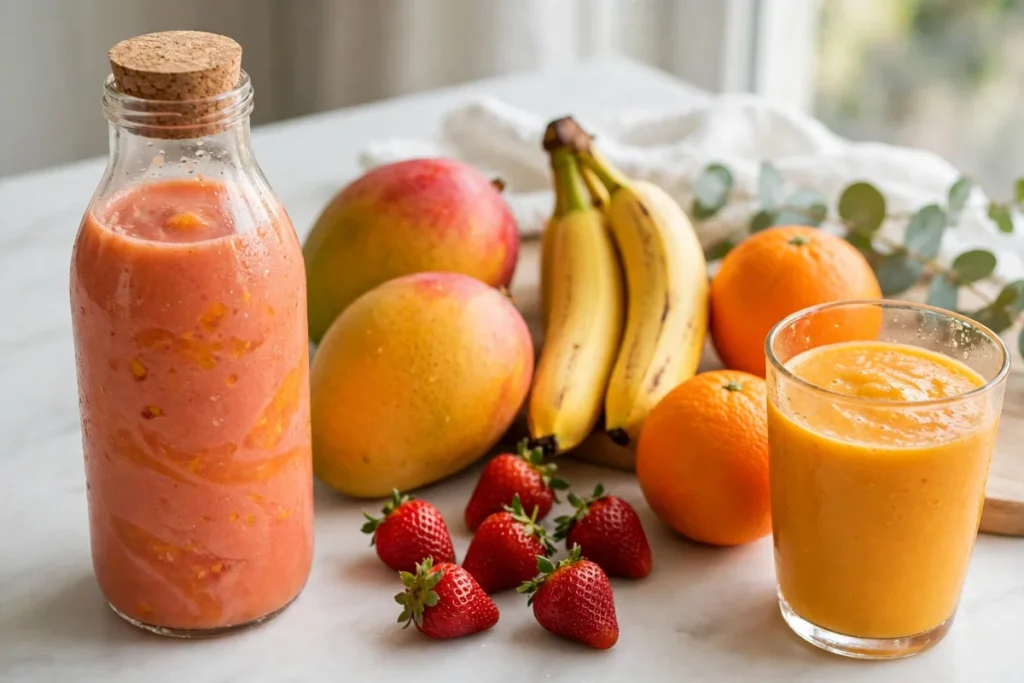

Is Naked Juice healthy? Short answer: Naked Juice is made from real fruit, with no added sugar — but it is not the health drink its bottle suggests. A standard 15.2 oz bottle packs 49–53 grams of sugar and 240–260 calories, which is more sugar than a 12 oz can of cola. Think of it as an occasional treat, not a daily health habit.
That verdict comes straight from the brand’s own current labels. Naked’s website (nakedjuice.com now redirects to nakedsmoothie.com) lists its drinks as “Machine” flavours, boosted with added chicory-root fibre (inulin) and vitamins. The fruit is real, and so is the sugar — and because that sugar is concentrated into a bottle you can finish in minutes, the maths matters more than the marketing.
What’s in a bottle? The official numbers
All figures below are per 15.2 fl oz bottle — the standard size — taken from the official Naked Smoothie product pages on 26 October 2026. Every flavour lists 0 g of added sugars; the sugar is all naturally occurring from the fruit juices and purees.
| Drink (15.2 fl oz bottle unless stated) | Calories | Total sugar | Protein | Fibre |
|---|---|---|---|---|
| Mighty Mango Machine | 260 | 51 g | 1 g | 6 g |
| Green Machine | 240 | 49 g | 2 g | 6 g |
| Strawberry Banana Machine | 250 | 50 g | 2 g | 6 g |
| Blue Machine | 250 | 53 g | 1 g | 6 g |
| Cola, 12 oz can (comparison) | 140 | 39 g | 0 g | 0 g |
| Whole orange (comparison) | 62 | 12 g | 1 g | 3 g |
| Whole apple (comparison) | 95 | 19 g | 0.5 g | 4 g |
A note on flavours: an earlier version of this article’s plan named Berry Blast, but Berry Blast is no longer in the brand’s current line-up — it does not appear on the official products page. Blue Machine, the current berry-flavoured option, takes its place in the table above.
For scale, a 12 oz cola has about 140 calories and 39 g of sugar. Every current Naked flavour beats that on sugar — by 10 to 14 grams — while also carrying 100 or more extra calories. The difference is what else comes with the sugar: vitamin C, potassium and 6 g of fibre, where cola brings nothing at all.
What is actually good about it
Fairness first: Naked Juice is a clear step up from soda and sweetened juice drinks, and the label backs that up. Every current flavour lists 0 g of added sugars — the sweetness comes from the fruit itself, not from syrup stirred in afterwards. The base is real fruit juices and purees, and the bottles deliver meaningful vitamin C and potassium: Mighty Mango Machine, for example, provides 180 mg of vitamin C (200% of the daily value) and 670 mg of potassium per bottle.
The current recipes also contain 6 g of fibre per bottle, thanks to added inulin from chicory root. That is far better than most juices, which typically contain almost no fibre at all. It does not make the drink equal to eating fruit — see below — but it is a genuine plus, and it is more than the brief for this article assumed.
The three problems
1. The sugar load
At 49–53 g of sugar per bottle, you are drinking roughly 12 to 13 teaspoons of sugar in one sitting. “No added sugar” does not mean low sugar: your body handles the natural sugars in juice much like any other sugar once they arrive in liquid form, and a bottle delivers them fast, with little to slow them down. For most adults, a single bottle already covers or exceeds the daily added-sugar limit many health authorities suggest as a maximum — and that is before anything else you eat all day.
2. The fibre is not the same as eating fruit
The 6 g of fibre in a bottle comes mostly from added inulin, not from the pulp of the fruit itself. Added fibre is better than none, but it does not reproduce what whole fruit does: chewing, slower eating, and a mix of fibre types that work together. Protein is also very low — just 1–2 g per bottle — so a bottle on its own does almost nothing to keep you full. A drink that is mostly sugar water with vitamins is still mostly sugar water.
3. Liquid calories do not fill you up
A 240–260 calorie bottle is easy to drink alongside a meal rather than instead of one, which is exactly how liquid calories sneak past your appetite. If you are watching your weight, that matters: a bottle can quietly add 10–15% to a day’s calorie budget without making you any less hungry at dinner. If you want to know what your own budget looks like, our guide to how many calories you should eat to lose weight walks through the maths.
Naked Juice vs eating the whole fruit
To get 51 g of sugar from whole fruit, you would need to eat about four oranges — and you would also get around 12 g of fibre, the time it takes to peel and chew them, and a much stronger feeling of fullness. A bottle compresses roughly that much fruit into a few minutes of drinking, with none of the chewing. That is the core difference: the same sugar, delivered in a way your body barely registers as food. Juice in general has this same problem — our breakdown of apple juice calories shows the same pattern, cup for cup.
Naked Juice vs a homemade smoothie
A homemade smoothie can be genuinely better, but only if you build it differently. Blend whole fruit (not juice) with vegetables, water or ice, and something protein-rich such as Greek yogurt — you keep the fibre, add staying power, and control the portion. A homemade version built half from fruit and half from vegetables, water and yogurt can match the flavour at roughly half the sugar of a bottled Naked. The catch: a homemade smoothie made from juice, banana and honey can land right back at 50 g of sugar, so the recipe matters more than the word “smoothie” on the label. If you want the protein side of that equation, see our guide to calories in protein.
Smarter ways to drink it
- Drink half a bottle, topped up with water and ice. You still get the flavour for about 25 g of sugar and 125 calories.
- Drink it with a meal, not alone. Protein and fibre from the meal slow the sugar hit and make the calories count as part of lunch, not an extra.
- Pick up the smaller 10 oz bottles when you can. The brand sells a smaller size, and it cuts both the sugar and the calories by about a third.
- Treat it as dessert, not breakfast. A bottle alongside a balanced breakfast stacks sugar on sugar; as an occasional sweet treat, it does far less damage.
- Check the flavour. Sugar ranges from 49 g (Green Machine) to 53 g (Blue Machine), so the label you pick does make a small difference.
Better alternatives
If you like the ritual of a fruity drink, whole fruit is the simplest upgrade, followed by a homemade smoothie built the way described above. Sparkling water with sliced citrus or berries gives you the flavour and fizz for effectively zero sugar. And if the bottle is really about convenience, a piece of fruit plus a bottle of water travels just as well and keeps you full far longer. A 250-calorie bottle is also a real chunk of a daily budget — if you have not checked yours, our maintenance calorie calculator will give you the number in under a minute.
The bottom line
So, is Naked Juice healthy? It is better than soda, it is made from real fruit, and it brings vitamins, potassium and 6 g of fibre to the table. But with 49–53 g of sugar and 240–260 calories per 15.2 oz bottle — more sugar than a can of cola — it works as an occasional treat, not a health drink. Enjoy it when you enjoy it, drink half a bottle when you can, and eat your fruit more often than you drink it.
Figures in this article are from the official Naked Smoothie product pages (nakedsmoothie.com), read on 26 October 2026, per 15.2 fl oz bottle. Cola, orange and apple values are standard reference values used for comparison.
Is Naked Juice good for weight loss?
Not especially. A 15.2 oz bottle has 240-260 calories and 49-53 g of sugar, and liquid calories rarely make you feel full, so it is easy to drink a bottle on top of your meals rather than instead of one. If you enjoy it, treat it as an occasional sweet drink and count the calories, or drink half a bottle with water and ice.
How much sugar is in a Naked Juice?
It depends on the flavour, but every current 15.2 oz bottle lands between 49 and 53 g of total sugar: Green Machine 49 g, Strawberry Banana Machine 50 g, Mighty Mango Machine 51 g and Blue Machine 53 g. None of it is added sugar, but it is still more sugar than a 12 oz cola, which has about 39 g.
Is Naked Juice healthier than soda?
Yes, but that is a low bar. A Naked bottle has more sugar than a cola, but it also brings vitamin C, potassium and 6 g of fibre, where cola brings nothing but sugar. Healthier than soda does not mean healthy: water, whole fruit or a homemade smoothie are all better everyday choices.
Is Naked Juice actually 100% juice?
Not in the way most people mean it. The drinks are built on fruit juices and purees, but the current recipes also add inulin fibre and vitamins, so they are boosted smoothies rather than plain pressed juice. The labels list 0 g of added sugars, but the total sugar is still 49-53 g per bottle.
What is a healthier alternative to Naked Juice?
Whole fruit is the simplest swap: an orange gives you about 12 g of sugar with 3 g of fibre for 62 calories, and chewing makes it far more filling. A homemade smoothie of whole fruit, vegetables, water or ice and Greek yogurt keeps the fibre and adds protein. Sparkling water with sliced fruit gives you the fruity flavour for effectively no sugar.